Legeza, Örs and Menczer, Andor and Ganyecz, Ádám and Werner, Miklós Antal and Kapás, Kornél and Hammond, Jeff and Xantheas, Sotiris S. and Ganahl, Martin and Neese, Frank (2025) Orbital Optimization of Large Active Spaces via AI-Accelerators. JOURNAL OF CHEMICAL THEORY AND COMPUTATION, 21 (13). pp. 6545-6558. ISSN 1549-9618
|
Text
pub12.pdf - Published Version Available under License Creative Commons Attribution. Download (3MB) | Preview |
|
![[img]](https://real.mtak.hu/224502/7/images_large_ct5c00571_0009.jpeg)
|
Text (graphical abstract)
images_large_ct5c00571_0009.jpeg - Published Version Available under License Creative Commons Attribution. Download (112kB) | Preview |
Abstract
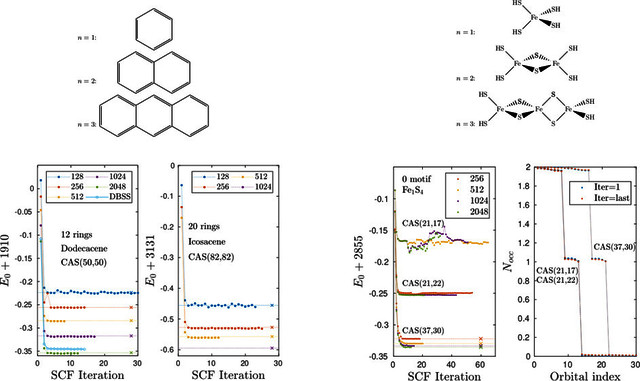
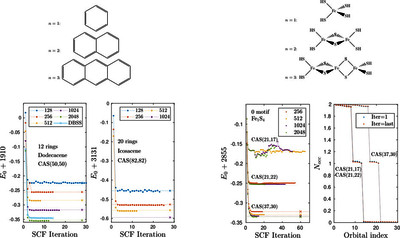
We present an efficient orbital optimization procedure that combines the highly GPU accelerated, spin-adapted density matrix renormalization group (DMRG) method with the complete active space self-consistent field (CAS-SCF) approach for quantum chemistry implemented in the ORCA program package. Leveraging the computational power of the latest generation of Nvidia GPU hardware, we perform CAS-SCF based orbital optimizations for unprecedented CAS sizes of up to 82 electrons in 82 orbitals [CAS(82,82)] in molecular systems comprising active space sizes of hundreds of electrons in thousands of orbitals. For both the NVIDIA DGX-A100 and DGX-H100 hardware, we provide a detailed scaling and error analysis of our DMRG-SCF approach for benchmark systems consisting of polycyclic aromatic hydrocarbons and iron–sulfur complexes of varying sizes. Our efforts demonstrate for the first time that highly accurate DMRG calculations at large bond dimensions are critical for obtaining reliably converged CAS-SCF energies. For the more challenging iron–sulfur benchmark systems, we furthermore find the optimized orbitals of a converged CAS-SCF calculation to depend more sensitively on the DMRG parameters than those for the polycyclic aromatic hydrocarbons. The ability to obtain converged CAS-SCF energies and orbitals for active spaces of such large sizes within days reduces the challenges of including the appropriate orbitals into the CAS or selecting the correct minimal CAS, and may open up entirely new avenues for tackling strongly correlated molecular systems.
| Item Type: | Article |
|---|---|
| Subjects: | Q Science / természettudomány > QC Physics / fizika Q Science / természettudomány > QD Chemistry / kémia > QD02 Physical chemistry / fizikai kémia |
| Depositing User: | Miklós Antal Werner |
| Date Deposited: | 23 Sep 2025 04:44 |
| Last Modified: | 23 Sep 2025 04:44 |
| URI: | https://real.mtak.hu/id/eprint/224502 |
Actions (login required)
 |
Edit Item |