Solymosi, Gergely T. and Kis, Tunde and Fürjes, Péter and Gyurcsanyi, Robert E. (2025) Absence of Hofmeister Selectivity in Hydrophobic Ion-Exchanger Nanopores. ANALYTICAL CHEMISTRY, 97 (49). pp. 27289-27297. ISSN 0003-2700
|
Text
absence.pdf - Published Version Available under License Creative Commons Attribution. Download (4MB) | Preview |
|
![[img]](https://real.mtak.hu/231188/7/graphical.jpeg)
|
Text (graphical abstract)
graphical.jpeg - Published Version Available under License Creative Commons Attribution. Download (163kB) | Preview |
Abstract
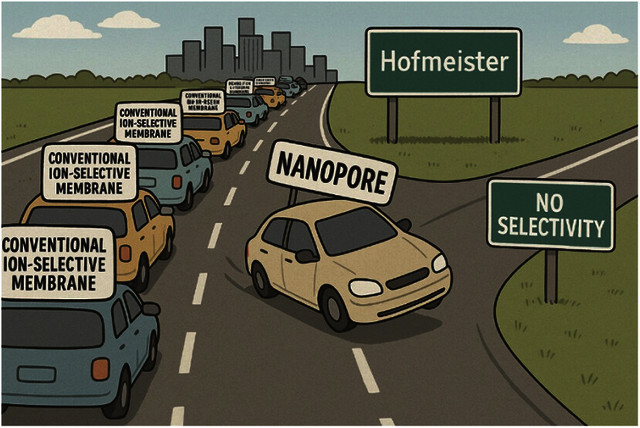
Dehydration governs ion selectivity in both natural ion channels and synthetic ion sieves, as ions must dehydrate to traverse subnanometer pores. Because lipophilic ions experience lower dehydration energy costs, an intrinsic lipophilic selectivity pattern known as the Hofmeister series arises. This Hofmeister selectivity is modulated in natural ion channels by electrostatic and coordinative interactions between ions and nanopore surfaces, yielding diverse selectivities. Ion selectivity has also been demonstrated in larger synthetic nanopores─up to 5 nm in diameter─functionalized with ionophores that enhance specific coordinative interactions. In these synthetic ion channels, surface hydrophobicity is critical for ion selectivity; however, its exact role remains undetermined. Here, we elucidate the contribution of hydrophobicity by comparing structurally identical hydrophilic and hydrophobic cation-exchanger gold nanopores modified with 10-mercaptodecane-1-sulfonate, a ligand lacking strong ion-coordinating functionalities. Zero-current potentiometry revealed that cation-exchanger nanopores do not discriminate among singly charged cations, except for a modest preference for H+. Remarkably, this behavior was observed in both hydrophilic and nanometer-wide hydrophobic nanopores, contrasting with the strong Hofmeister selectivity of subnanometer pores and hydrophobic bulk polymer membranes. The absence of Hofmeister selectivity was confirmed in both multipore membranes and single nanopores, ruling out ensemble nonidealities as an explanation. These findings indicate that surface hydrophobicity alone does not impart lipophilicity-driven discrimination to cation-exchanger nanopores. The lack of intrinsic Hofmeister selectivity may enable unique ion-sensing applications (e.g., total ion concentration measurements, ligand-tuned ion-selective sensors) by minimizing interference from lipophilic species that commonly affect polymer-based sensing membranes, while still excluding bulk electrolyte from the pores.
| Item Type: | Article |
|---|---|
| Uncontrolled Keywords: | Hydrophobicity, Ions, Membranes, Nanopores, Selectivity |
| Subjects: | Q Science / természettudomány > Q1 Science (General) / természettudomány általában |
| SWORD Depositor: | MTMT SWORD |
| Depositing User: | MTMT SWORD |
| Date Deposited: | 02 Jan 2026 15:02 |
| Last Modified: | 02 Jan 2026 15:02 |
| URI: | https://real.mtak.hu/id/eprint/231188 |
Actions (login required)
 |
Edit Item |