Bulátkó, Anna and Höfler, Lajos and Kéri, Mónika and Majzik, Tamás István and Mohai, Miklós Péter and Sáfrán, György and Sebestyén, Zoltán and Nagyné László, Krisztina (2025) Role of texture and surface chemistry in interaction of graphene oxides with water. JOURNAL OF MOLECULAR LIQUIDS, 438. No. 128722. ISSN 0167-7322
![[img]](https://real.mtak.hu/style/images/fileicons/text.png) |
Text
1-s2.0-S0167732225018999-main.pdf - Published Version Restricted to Registered users only Download (3MB) | Request a copy |
|
![[img]](https://real.mtak.hu/231195/7/1-s2.0-S0167732225018999-ga1_lrg.jpg)
|
Text
1-s2.0-S0167732225018999-ga1_lrg.jpg - Published Version Download (177kB) | Preview |
Abstract
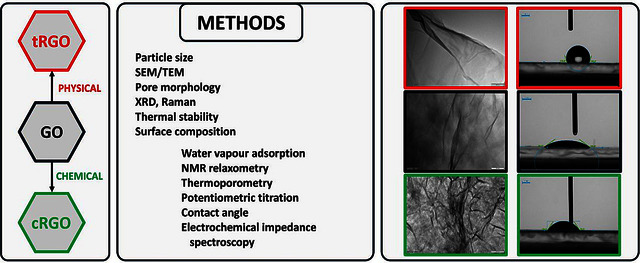
Hydrophilic graphene oxide (GO) has deservedly attained wide recognition in materials science. Its hydrophilic character, which facilitates its processability, opens new avenues in a wide range of applications. In membranes employed in water treatment or in electrical devices, for example, the solid surface – water interaction plays a key role in its performance. Major characteristic features of graphene that are sacrificed during wet exfoliation were at least partially restored by a mild thermal and green chemical reduction process to yield two reduced GOs with significantly different textures but apparently similar chemical composition. The samples were comprehensively characterised with multiple techniques including microscopic imaging, N<inf>2</inf> adsorption, powder X-ray diffraction, Raman and X-ray photoelectron spectroscopy. To reveal how the textural and chemical differences observed in “dry” conditions are manifested in the presence of water, the samples were exposed to water in the vapor and liquid state, respectively. The results reveal a synergy of surface chemistry and relative humidity. In contact with liquid water the pore texture overcomes the effect of surface chemistry in the melting/freezing transition, while surface chemistry dominates the surface charge and thus the performance against charged dissolved species: lower O/C ratios lead to higher pH<inf>PZC</inf>. Electrochemical impedance spectroscopy reveals that samples with a high concentration of surface functional groups are more efficient in reducing charge transfer resistance. These findings show the importance of controlling the reduction method to optimize the performance of graphite oxide-based materials in an aqueous environment.
| Item Type: | Article |
|---|---|
| Uncontrolled Keywords: | Water vapor, TG/MS, NMR relaxometry, Surface titration, EIS |
| Subjects: | Q Science / természettudomány > QD Chemistry / kémia |
| SWORD Depositor: | MTMT SWORD |
| Depositing User: | MTMT SWORD |
| Date Deposited: | 02 Jan 2026 15:15 |
| Last Modified: | 02 Jan 2026 15:15 |
| URI: | https://real.mtak.hu/id/eprint/231195 |
Actions (login required)
 |
Edit Item |