Fertő, Imre and Csurilla, Gergely and Podruzsik, Szilárd (2026) Assessing the impact of agri-environmental schemes on input use in Hungary's wine sector : Implications for sustainability and policy design. ENVIRONMENTAL DEVELOPMENT, 58. No. 101424. ISSN 2211-4645
|
Text
1-s2.0-S2211464525002908-main.pdf - Published Version Available under License Creative Commons Attribution Non-commercial. Download (797kB) | Preview |
|
![[img]](https://real.mtak.hu/231547/7/1-s2.0-S2211464525002908-ga1_lrg.jpg)
|
Text (graphical abstract)
1-s2.0-S2211464525002908-ga1_lrg.jpg - Published Version Available under License Creative Commons Attribution Non-commercial. Download (577kB) | Preview |
Abstract
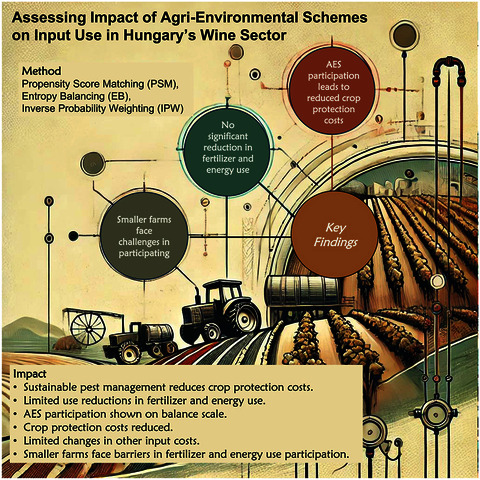
Agri-Environmental Schemes (AES) are a key policy tool within the European Union's Common Agricultural Policy (CAP) aimed at promoting sustainable farming practices and mitigating environmental externalities. However, their effectiveness in reducing input use in high-value, resource-intensive sectors such as viticulture remains uncertain. This study evaluates the impact of AES participation on input expenditures in Hungary's wine sector, focusing on fertilizer use, crop protection costs, and energy consumption. Using a robust econometric approach - Propensity Score Matching (PSM), Entropy Balancing (EB), and Inverse Probability Weighting (IPW) - the analysis addresses selection bias and estimates the causal effects of AES participation. Findings indicate that AES participation significantly reduces crop protection costs, suggesting a shift towards more sustainable pest management practices. However, no significant effects are observed on fertilizer or energy expenditures, highlighting potential gaps in AES design concerning these critical inputs. Additionally, results suggest that AES participants manage larger, resource-abundant farms, raising concerns about the inclusivity of the scheme. These findings underscore the need for targeted policy refinements to enhance the effectiveness of AES in viticulture, particularly by improving accessibility for smaller farms and strengthening incentives for input reduction. The study contributes to the broader discourse on agri-environmental policy by providing empirical evidence to inform the design of more effective and inclusive sustainability interventions in the European wine sector.
| Item Type: | Article |
|---|---|
| Uncontrolled Keywords: | Agri-environmental schemes, Wine sector, Sustainability, Policy evaluation, Input use, Hungary |
| Subjects: | J Political Science / politológia > JA Political science (General) / politológia általában S Agriculture / mezőgazdaság > S1 Agriculture (General) / mezőgazdaság általában |
| SWORD Depositor: | MTMT SWORD |
| Depositing User: | MTMT SWORD |
| Date Deposited: | 06 Jan 2026 14:27 |
| Last Modified: | 06 Jan 2026 14:27 |
| URI: | https://real.mtak.hu/id/eprint/231547 |
Actions (login required)
 |
Edit Item |