Nooten, Sabine S. and Kárpáti, Zsolt and Neumayer, Johann and Becsi, Benedikt and Formayer, Herbert and Schmitt, Thomas (2026) Cuticular hydrocarbons in bumblebees change with age and vary with climate along an elevational temperature gradient. SCIENCE OF THE TOTAL ENVIRONMENT, 1014. No. 181310. ISSN 0048-9697
|
Text
1-s2.0-S0048969725029523-main.pdf - Published Version Available under License Creative Commons Attribution Non-commercial No Derivatives. Download (5MB) | Preview |
|
![[img]](https://real.mtak.hu/231708/7/1-s2.0-S0048969725029523-ga1_lrg.jpg)
|
Text (graphical abstract)
1-s2.0-S0048969725029523-ga1_lrg.jpg - Published Version Available under License Creative Commons Attribution Non-commercial No Derivatives. Download (276kB) | Preview |
Abstract
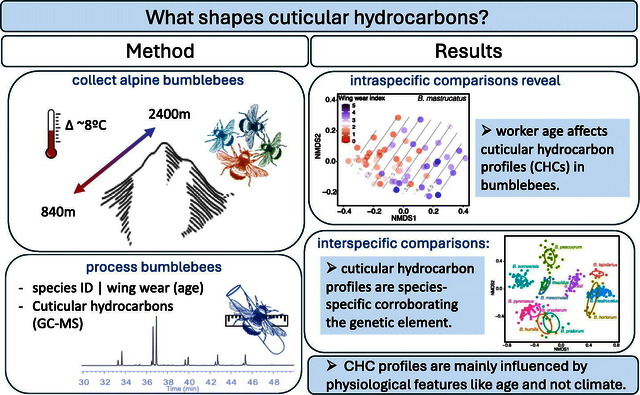
Avoiding desiccation is paramount for all terrestrial insects, especially in climatically challenging mountainous environments characterised by rapid changes in temperature. A key component in the insects' repertoire to avoid water loss is a thin waxy layer on the insects' cuticle - the cuticular hydrocarbons (CHCs). These can be modified to reduce cuticular transpiration, but they are also restricted by their communication function and by physiological properties like age. Here, we use montane bumblebees to assess the relative importance of abiotic features (temperature) and internal factors (relatedness and age) in ‘shaping’ the cuticular hydrocarbon profiles. We perform inter- and intraspecific comparisons of twelve species collected along a 1560 m elevational climate gradient (from 800 to 2400 m a.s.l.). Intraspecific analyses revealed that the cuticular hydrocarbon profiles are associated with bumblebee worker age. Interspecific comparisons showed that cuticular hydrocarbon profiles are species-specific corroborating the genetic element. Our results suggest that the cuticular hydrocarbon profile responses to abiotic factors - like temperature and humidity - are constrained by physiological features. This highlights the intricacy of different features shaping the CHC profiles and raises issues about the acclimatisation capability of these important pollinators to climate changes. We suggest that future investigations of cuticular hydrocarbon profiles should incorporate physiological features that are related to fitness, such as the insects' nutrition, body size and fat content.
| Item Type: | Article |
|---|---|
| Subjects: | G Geography. Anthropology. Recreation / földrajz, antropológia, kikapcsolódás > GE Environmental Sciences / környezettudomány Q Science / természettudomány > QH Natural history / természetrajz > QH540 Ecology / ökológia |
| SWORD Depositor: | MTMT SWORD |
| Depositing User: | MTMT SWORD |
| Date Deposited: | 08 Jan 2026 15:24 |
| Last Modified: | 08 Jan 2026 15:24 |
| URI: | https://real.mtak.hu/id/eprint/231708 |
Actions (login required)
 |
Edit Item |