Kovács, Hilda and Hajdu, Bálint and May, Nóra V. and Lihi, Norbert and Szatmári, István and Szakács, Gergely and Enyedy, Éva Anna (2026) A Comparative Study on the Iron and Copper Binding Properties of 8-Hydroxyquinoline-Derived Mannich Bases Targeting Multidrug-Resistance Cancer Cells. ACS OMEGA. ISSN 2470-1343 (In Press)
|
Text
a-comparative-study-on-the-iron-and-copper-binding-properties-of-8-hydroxyquinoline-derived-mannich-bases-targeting.pdf - Published Version Available under License Creative Commons Attribution. Download (6MB) | Preview |
|
![[img]](https://real.mtak.hu/231847/7/images_large_ao5c06872_0014.jpeg)
|
Text (graphical abstract)
images_large_ao5c06872_0014.jpeg - Published Version Available under License Creative Commons Attribution. Download (175kB) | Preview |

Abstract
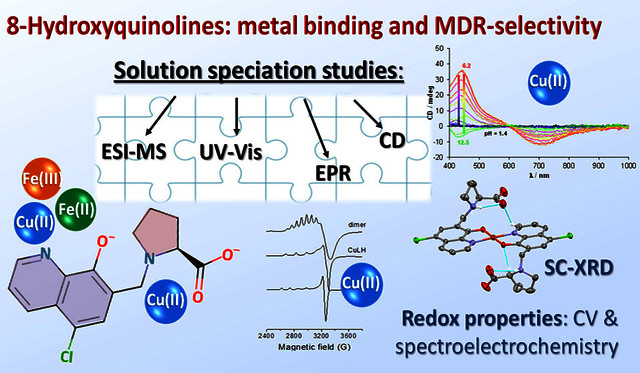
The efficacy of 8-hydroxyquinoline (HQ) Mannich bases against multidrug-resistant (MDR) cancer cells is thought to be linked to the complexation with essential metal ions such as iron and copper. Here, the complex formation equilibria of five MDR-selective HQs with Fe(II), Fe(III), and Cu(II) were studied by UV–visible spectrophotometry, complemented by electron paramagnetic resonance, circular dichroism, and electrospray ionization mass spectrometry techniques. Cyclic voltammetry and spectroelectrochemistry were used to map the redox characteristics of the complexes, and their direct reactivity with glutathione was also monitored. Single-crystal X-ray diffraction was applied to determine the structures of one of the selected ligands (HQCl-l-Pro) and its bis-ligand Cu(II) complex. The ligands are coordinated to Fe(II) and Fe(III) via the (N,O–) donor set in all cases, leading to the formation ofmono-, bis-, and tris-ligand complexes. For Cu(II) complexes of amino acid conjugates, several species have been identified. In addition to mono- and bis-ligand complexes, dimeric species are also formed, supported by density functional theory calculations. At pH 7.4, the carboxylate-containing ligands bind metal ions in the stability order of: Fe(II) < Fe(III) < Cu(II). Ligands without carboxylate side chains (HQCl-pyr and HQCl-pip) and with increased MDR-selectivity showed a higher preference for Fe(II) than for Fe(III), also reflected in the more positive redox potentials.
| Item Type: | Article |
|---|---|
| Subjects: | Q Science / természettudomány > QD Chemistry / kémia |
| SWORD Depositor: | MTMT SWORD |
| Depositing User: | MTMT SWORD |
| Date Deposited: | 12 Jan 2026 12:23 |
| Last Modified: | 12 Jan 2026 12:23 |
| URI: | https://real.mtak.hu/id/eprint/231847 |
Actions (login required)
 |
Edit Item |