Bojnec, Štefan and Fertő, Imre (2026) Do agri-environmental schemes reduce farm greenhouse gas emissions? Evidence from Slovenia. SCIENCE OF THE TOTAL ENVIRONMENT, 1014. No. 181387. ISSN 0048-9697
|
Text
1-s2.0-S0048969726000446-main.pdf - Published Version Available under License Creative Commons Attribution Non-commercial No Derivatives. Download (2MB) | Preview |
|
![[img]](https://real.mtak.hu/232100/7/1-s2.0-S0048969726000446-ga1_lrg.jpg)
|
Text (graphical abstract)
1-s2.0-S0048969726000446-ga1_lrg.jpg - Published Version Available under License Creative Commons Attribution Non-commercial No Derivatives. Download (86kB) | Preview |
Abstract
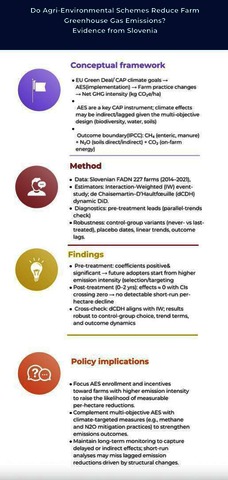
Reducing greenhouse gas (GHG) emissions from agriculture is a key objective of the European Union's Green Deal and is among considerations of the Common Agricultural Policy (CAP). Agri-environmental schemes (AES) are the main CAP instruments to promote more sustainable farming, yet their short-term climate effectiveness remains uncertain. This study provides the first farm-level evidence for Slovenia on whether AES participation reduces GHG emission intensity and whether effects differ across production systems. Using a balanced panel of 227 farms from the Farm Accountancy Data Network (2014–2021), we estimate dynamic treatment effects of AES adoption on net carbon dioxide-equivalent emissions per hectare, applying modern difference-in-differences (DiD) estimators for staggered adoption and extensive robustness checks, including alternative estimators, placebo tests, and dynamic conditioning. Results show that AES adopters had higher pre-adoption emission intensity, consistent with targeted uptake by higher-emission farms. However, estimated reductions in emission intensity during the first one to two years after adoption are small, statistically insignificant, and robust across specifications. These findings suggest that broad, practice-based AES may not deliver immediate, measurable climate benefits at the farm level, either because effects take longer to materialize or because current schemes are insufficiently targeted to high-emission sources. Policies that combine more precise targeting, climate-specific measures, and long-term monitoring may be needed to unlock the full climate mitigation potential of AES.
| Item Type: | Article |
|---|---|
| Uncontrolled Keywords: | Agri-environmental schemes, Greenhouse gas emissions, Difference-in-differences, Agricultural policy evaluation, Slovenia |
| Subjects: | S Agriculture / mezőgazdaság > S1 Agriculture (General) / mezőgazdaság általában |
| SWORD Depositor: | MTMT SWORD |
| Depositing User: | MTMT SWORD |
| Date Deposited: | 15 Jan 2026 10:14 |
| Last Modified: | 15 Jan 2026 10:14 |
| URI: | https://real.mtak.hu/id/eprint/232100 |
Actions (login required)
 |
Edit Item |