Baráth, Benjámin Regő and Bojcsuk, Dóra and Bene, Krisztián and Caballero-Sánchez, Noemí and Cseh, Tímea and de Freitas, João Cr and Tzerpos, Petros and Tóth, Márta and Tang, Zhonghua and Guller, Seth and Krasznai, Zoárd Tibor and Neuperger, Patricia and Szebeni, Gábor and Nagy, Gergely and Deli, Tamás and Nagy, Laszlo (2025) Distinct transcriptional and epigenomic programs define Hofbauer cells in term placenta. JCI INSIGHT. ISSN 2379-3708 (In Press)
|
Text
BarathBJCII.pdf - Accepted Version Download (6MB) | Preview |
|
![[img]](https://real.mtak.hu/233506/7/195801-INS-TA-RV-3_ga_961755.jpg)
|
Text (graphical abstract)
195801-INS-TA-RV-3_ga_961755.jpg - Accepted Version Download (166kB) | Preview |
Abstract
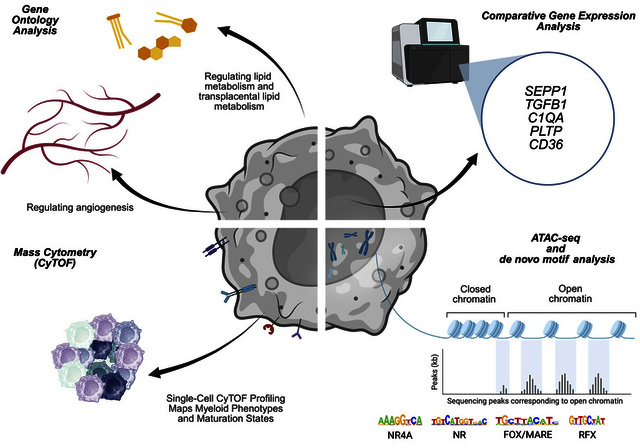
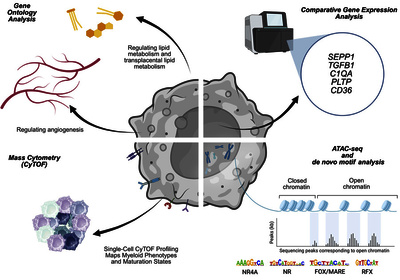
Hofbauer cells (HBC) are fetal-derived macrophages located in the placenta that contribute to antimicrobial defense, angiogenesis, tissue remodeling, and metabolic processes within the chorionic villi. Although their roles in placental biology are increasingly recognized, the mechanisms that regulate HBC identity and function are not yet fully defined. This study aimed to define the core transcriptomic and epigenomic features of HBCs in term placentas and to examine their capacity for transcriptional responsiveness and phenotypic variation. Using chromatin accessibility profiling and bulk RNA sequencing, we found that HBCs exhibit a unique gene expression and chromatin accessibility profile compared to other fetal and adult macrophages. We identified a coordinated transcriptional network involving nuclear receptors NR4A1-3, the glucocorticoid receptor (GR), and RFX family members (RFX1, RFX2, RFX5) that appears to shape HBC identity, particularly through pathways linked to lipid metabolism and angiogenesis. Although exploratory in nature, in vitro stimulation studies showed that HBCs exhibited increased transcriptional activity in response to combined IL-4 and RSG treatment, including induction of the lipid transporter CD36. Mass cytometry analysis revealed surface markers indicative of both immature and mature macrophage states. Together, these results indicated that HBCs represent a distinct and diverse macrophage population with specialized and adaptable regulatory program in the human placenta.
| Item Type: | Article |
|---|---|
| Uncontrolled Keywords: | MACROPHAGES; immunology; reproductive biology; |
| Subjects: | Q Science / természettudomány > QH Natural history / természetrajz > QH301 Biology / biológia |
| SWORD Depositor: | MTMT SWORD |
| Depositing User: | MTMT SWORD |
| Date Deposited: | 08 Feb 2026 09:37 |
| Last Modified: | 08 Feb 2026 09:37 |
| URI: | https://real.mtak.hu/id/eprint/233506 |
Actions (login required)
 |
Edit Item |