Horváth, Gyöngyi and Plesz, Szonja Bianka and Ducza, Eszter and Varga, Dorottya and Szucs, Edina and Benyhe, Sándor and Adlan, Leatitia Gabriella and Braunitzer, Gábor and Kékesi, Gabriella (2025) Repurposing Caffeine, Metformin, and Furosemide to Target Schizophrenia-Related Impairments in a Triple-Hit Rat Model. INTERNATIONAL JOURNAL OF MOLECULAR SCIENCES, 26 (13). No. 6019. ISSN 1661-6596
|
Text
HorvathIJMS.pdf - Published Version Available under License Creative Commons Attribution. Download (1MB) | Preview |
|
![[img]](https://real.mtak.hu/233704/7/ijms-26-06019-ag.png)
|
Text (graphical abstract)
ijms-26-06019-ag.png - Published Version Download (855kB) | Preview |
Abstract
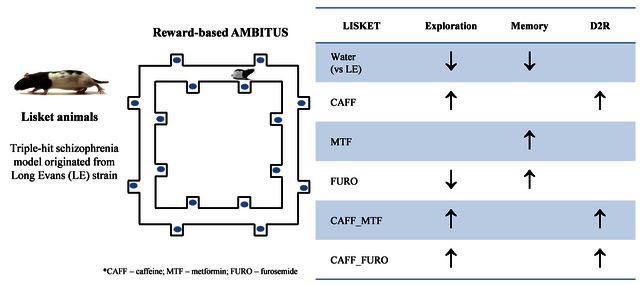
The limited efficacy of antipsychotics in treating the negative and cognitive symptoms of schizophrenia has prompted the exploration of adjuvant therapies. Several drugs developed for other indications-including caffeine, metformin, and furosemide-have shown procognitive potential. This study evaluated the effects of these agents on behavioral parameters using the reward-based Ambitus test, and on the cerebral D2 dopamine receptor (D2R) expression and binding. The drugs were administered individually and in combination in a schizophrenia-like triple-hit animal model (Lisket rats), derived from the Long Evans (LE) strain. Lisket rats received 14 days of drug treatment via drinking water; water-drinking LE rats served as the controls. The Ambitus test was conducted before treatment and on days 11-14. Caffeine enhanced activity without affecting learning or memory. Metformin and furosemide reduced exploratory behavior but improved reference memory; these effects were inhibited by caffeine co-administration. Although no statistically significant behavioral differences were found compared to water-treated Lisket rats, a trend toward reduced exploratory visits was observed in the triple-combination group. Lisket rats exhibited moderately reduced D2R binding in the cortex and increased binding in the hippocampus. Caffeine alone and in combination enhanced hippocampal D2R binding, while furosemide increased cortical D2R expression. This study is the first to highlight the behavioral and molecular effects of these non-antipsychotic agents in a schizophrenia model, supporting their potential for adjunctive use.
| Item Type: | Article |
|---|---|
| Additional Information: | Funding Agency and Grant Number: University of Szeged Open Access Fund Funding text: This work was supported by the University of Szeged Open Access Fund 7731. |
| Uncontrolled Keywords: | SCHIZOPHRENIA; BEHAVIOR; INHIBITION; DEFICITS; CAFFEINE; ANIMAL-MODEL; furosemide; COGNITIVE IMPAIRMENT; metformin; MEMORY IMPAIRMENT; ADENOSINE A(1); Biochemistry & Molecular Biology; BRAIN-REGIONS; D2 dopamine receptor; dopamine hypothesis; NKCC1; Long Evans; |
| Subjects: | Q Science / természettudomány > QH Natural history / természetrajz > QH301 Biology / biológia > QH3015 Molecular biology / molekuláris biológia |
| SWORD Depositor: | MTMT SWORD |
| Depositing User: | MTMT SWORD |
| Date Deposited: | 11 Feb 2026 13:28 |
| Last Modified: | 11 Feb 2026 13:28 |
| URI: | https://real.mtak.hu/id/eprint/233704 |
Actions (login required)
 |
Edit Item |