Kondak, Dóra and Imre-Deák, Ágota and Rónavári, Andrea and Bodor, Tamás Dávid and Kondak, Selahattin and Adedokun, Oluwatosin Peace and Benkő, Péter and Szőllősi, Réka and Szalai, Gabriella and Janda, Tibor and Ayaydin, Ferhan and Lindermayr, Christian and Kónya, Zoltán and Kolbert, Zsuzsanna (2025) Chitosan encapsulated S-nitrosoglutathione is an efficient nanodonor in Brassica napus seedlings. PLANT PHYSIOLOGY AND BIOCHEMISTRY, 227. No. 110184. ISSN 0981-9428
|
Text
1-s2.0-S0981942825007120-main.pdf - Published Version Available under License Creative Commons Attribution Non-commercial No Derivatives. Download (14MB) | Preview |
|
![[img]](https://real.mtak.hu/235561/7/1-s2.0-S0981942825007120-ga1_lrg.jpg)
|
Text (graphical abstract)
1-s2.0-S0981942825007120-ga1_lrg.jpg - Published Version Available under License Creative Commons Attribution Non-commercial No Derivatives. Download (271kB) | Preview |
Abstract
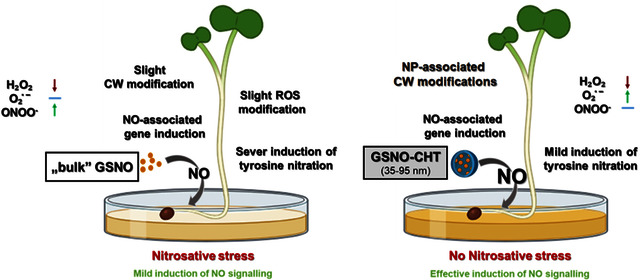
Nitric oxide (NO) supplementation promotes plant development and stress endurance. To overcome the stability and toxicity issues of conventional NO donors, nanoencapsulation may offer a solution. This study used a model system in which 5-day-old Brassica napus L. seedlings were exposed via their root system for 2 h with either bulk S-nitrosoglutathione (GSNO), chitosan-encapsulated GSNO nanoparticles (GSNO-CHT NPs), or empty chitosan nanoparticles (CHT NPs), at concentrations of 250 and 500 μM. Nanoparticle-associated cell wall modifications of the seedlings’ roots and rhizosphere acidification was observed. Fluorescein isothiocyanate (FITC) labelled GSNO-CHT NPs revealed that the internalization of GSNO-CHT-FITC NPs into plant roots was significantly less efficient than that of CHT-FITC NPs. Nano GSNO overperformed bulk GSNO in regards of the intensity and sustainability of in vitro NO release, the rate of in planta NO accumulation and induction of S-nitrosothiol (SNO) signalling (SNO levels, nitrite levels, BnNIA1 expression). The GSNO reductase was not activated and the GSNO levels were reduced less by nano NO donor compared to the bulk from. Bulk GSNO-triggered accumulation of free cysteine suggests stress-state of the seedlings in contrast to the milder effect of GSNO-CHT NPs. Additionally, encapsulation of GSNO prevented nitrosative stress induction due to the lack of peroxynitrite induction and slightly increasing protein tyrosine nitration, while bulk GSNO proved to be pronitrant in the seedlings. By exploring the interaction between GSNO-CHT NPs and plants from multiple angles for the first time, this study demonstrates the efficacy of GSNO-CHT NPs as an effective, controlled, non-toxic NO donor for plants.
| Item Type: | Article |
|---|---|
| Uncontrolled Keywords: | Nitric oxide delivery; Nanoparticles; Reactive nitrogen species; S-nitrosothiol signaling |
| Subjects: | Q Science / természettudomány > QH Natural history / természetrajz > QH301 Biology / biológia |
| SWORD Depositor: | MTMT SWORD |
| Depositing User: | MTMT SWORD |
| Date Deposited: | 11 Mar 2026 14:57 |
| Last Modified: | 11 Mar 2026 14:57 |
| URI: | https://real.mtak.hu/id/eprint/235561 |
Actions (login required)
 |
Edit Item |