Tan, Jingwen and Fu, Zhenzhen and Han, Mingzhi and Wong, Nga-Lee and Song, Chenghao and Chen, Yin and Li, Wenjia and Deli, Mária Anna and Zhang, Hailou and Chen, Gang (2025) Sijunzi Decoction treatment improved depression with qi deficiency/fatigue in the strain-dependent manner, involved in anti-inflammation in the hippocampus and muscles. JOURNAL OF ETHNOPHARMACOLOGY, 353. No. 120380. ISSN 0378-8741
![[img]](https://real.mtak.hu/style/images/fileicons/text.png) |
Text
TanJingwen.pdf - Published Version Restricted to Registered users only Download (7MB) | Request a copy |
|
![[img]](https://real.mtak.hu/235895/7/1-s2.0-S0378874125010724-ga1_lrg.jpg)
|
Text
1-s2.0-S0378874125010724-ga1_lrg.jpg - Published Version Download (275kB) | Preview |
Abstract
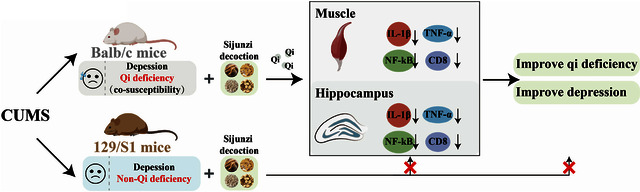
Ethnopharmacological relevance In the traditional Chinese medicine (TCM) clinic, qi deficiency is a common syndrome pattern in major depressive disorder (MDD). Sijunzi decoction (SJZD), a classic muti-herbal formula to replenish qi and nourish blood, is widely used to treat qi deficiency syndrome. The symptoms of qi deficiency are very similar to fatigue. Currently the mainstream antidepressant treatment outcome for depression with fatigue remains unsatisfying. SJZD has potential for improvement in the treatment of depression with qi deficiency, which has not been scientifically characterized previously. Aim of the study The study aimed to test the effects of SJZD in a mouse model of depression with qi deficiency/fatigue and to investigate the associated mechanisms, focusing on inflammation in the hippocampus and muscles. Materials and methods Balb/c and 129S1/SvImJ (129/S1) strains of mice were compared for depression-like and qi deficiency-like behaviors following receiving the same procedure of chronic unpredictable mild stress (CUMS). Qi deficiency behavior was assessed using grip strength test (GST), exhaustive swimming test (EST) and degree of redness (DOR). Depressive behavior was assessed using sucrose preference test (SPT), tail suspension test (TST), and forced swimming test (FST). SJZD was administrated for 1 week in CUMS-exposed mice in both strains. The conventional antidepressant fluoxetine (FLX), ineffective to fatigue/qi deficiency, was used to compared with SJZD, qPCR was used to detect gene expressions of inflammatory factors in the hippocampus and muscles in both strains. Results Balb/c and 129/S1 mice both showed depressive symptoms comparably after exposed to CUMS. However, qi deficiency symptoms were only shown in Balb/c mice, with decreased grip strength in GST, reduced swimming times in EST and decreased degree of redness in DOR. SJZD was able to reverse both depressive deficits and qi deficiency in Balb/c mice, without influencing 129/S1 mice. Consistent with the depression-phenotype, the expressions of the inflammatory factors including IL-1β, TNF-α, NF-kB and CD8 in the hippocampus were upregulated in both Balb/c and 129/S1 mice, which were reversed by SJZD only in Balb/c mice. Consistent with the qi deficiency-phenotype, the expressions of these inflammatory factors were up-regulated in the muscles only in Balb/c mice, which were reversed by SJZD. In contrast, FLX elicited antidepressant effects without changing qi deficiency in Balb/c mice, consistent with its improvement of inflammation in the hippocampus, but not muscles. Conclusions Balb/c strain mice showed co-susceptibility to depression and qi deficiency/fatigue following CUMS, both of which were alleviated by SJZD. These effects were associated with the suppression of inflammation in the hippocampus and muscles respectively, suggesting that the anti-inflammation effects of SJZD on both brain and the peripheral systems may play a part in qi-replenishing and antidepressant functions. Our study provides the first scientific evidence, leveraging animal genetics, to demonstrate the necessity and efficacy of stratified treatment of depression, using TCM treatment based on syndrome differentiation.
| Item Type: | Article |
|---|---|
| Additional Information: | Funding Agency and Grant Number: National Natural Science Foundation of China [81874374, 82174002, 82404884]; Guangzhou Key Science and Technology R D Project [202206010109]; Fundamental Research Funds for the Central Universities [21625362] Funding text: The study was supported the National Natural Science Foundation of China (81874374, 82174002, 82404884) , Guangzhou Key Science and Technology R & D Project (202206010109) , the Fundamental Research Funds for the Central Universities (21625362) . Part number: A |
| Uncontrolled Keywords: | Major depressive disorder, qi deficiency, Sijunzi decoction, Inflammation, Muscles, Hippocampus |
| Subjects: | Q Science / természettudomány > QH Natural history / természetrajz > QH301 Biology / biológia |
| SWORD Depositor: | MTMT SWORD |
| Depositing User: | MTMT SWORD |
| Date Deposited: | 19 Mar 2026 08:58 |
| Last Modified: | 19 Mar 2026 08:58 |
| URI: | https://real.mtak.hu/id/eprint/235895 |
Actions (login required)
 |
Edit Item |