Tarnopol, Rebecca L. and Tamsil, Josephine A. and Cinege, Gyöngyi Ilona and Ha, Ji Heon and Verster, Kirsten I. and Ábrahám, Edit and Magyar, Lilla Brigitta and Kim, Bernard Y. and Bernstein, Susan L. and Lipinszki, Zoltán and Andó, István and Whiteman, Noah K. (2025) Experimental horizontal transfer of phage-derived genes to Drosophila confers innate immunity to parasitoids. CURRENT BIOLOGY, 35 (3). 514-529.e7. ISSN 0960-9822
|
Text
TarnopolR.pdf - Published Version Available under License Creative Commons Attribution. Download (10MB) | Preview |
|
![[img]](https://real.mtak.hu/235896/7/fx1_lrg.jpg)
|
Text (graphical abstract)
fx1_lrg.jpg - Published Version Available under License Creative Commons Attribution. Download (203kB) | Preview |
Abstract
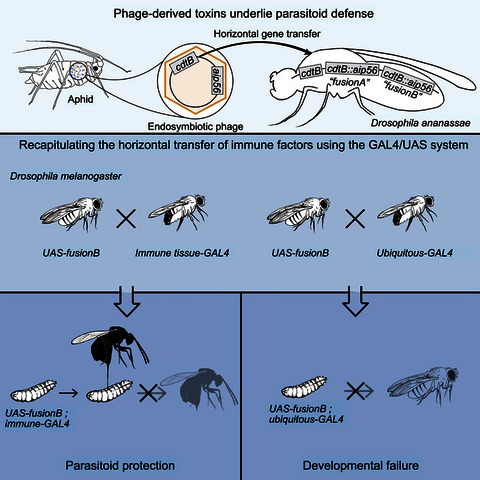
Metazoan parasites have played a major role in shaping innate immunity in animals. Insect hosts and parasitoid wasps are excellent models for illuminating how animal innate immune systems have evolved to neutralize these enemies. One such strategy relies on symbioses between insects and intracellular bacteria that express phage-encoded toxins. In some cases, the genes that encode these toxins have been horizontally transferred to the genomes of the insects. Here, we used genome editing in Drosophila melanogaster to recapitulate the evolution of two toxin genes—cytolethal distending toxin B (cdtB) and apoptosis inducing protein of 56kDa (aip56)—that were horizontally transferred likely from phages of endosymbiotic bacteria to insects millions of years ago. We found that a cdtB::aip56 fusion gene (fusionB), which is conserved in D. ananassae subgroup species, dramatically promoted fly survival and suppressed parasitoid wasp development when heterologously expressed in D. melanogaster immune tissues. We found that FusionB was a functional nuclease and was secreted into the host hemolymph where it targeted the parasitoid embryo's serosal tissue. Although the mechanism of toxicity remains unknown, when expressed ubiquitously, fusionB resulted in delayed development of late-stage fly larvae and eventually killed pupating flies. These results point to the salience of regulatory constraint in mitigating autoimmunity during the domestication process following horizontal transfer. Our findings demonstrate how horizontal gene transfer can instantly provide new, potent innate immune modules in animals. © 2024 The Author(s)
| Item Type: | Article |
|---|---|
| Additional Information: | Innate Immunity Group, Institute of Genetics, HUN-REN Biological Research Centre, Szeged, 6726, Hungary Synthetic and Systems Biology Unit, Institute of Biochemistry, HUN-REN Biological Research Centre, Szeged, 6726, Hungary National Laboratory for Biotechnology Institute of Genetics, HUN-REN Biological Research Centre, Szeged, 6726, Hungary |
| Uncontrolled Keywords: | Animals; GENETICS; DROSOPHILA; immunology; animal; physiology; innate immunity; parasitology; Drosophila melanogaster; Immunity, Innate; bacteriophage; symbiosis; PHAGE; horizontal gene transfer; Wasps; Bacteriophages; Parasitoid; WASP; Gene Transfer, Horizontal; CdtB; |
| Subjects: | Q Science / természettudomány > QH Natural history / természetrajz > QH301 Biology / biológia |
| SWORD Depositor: | MTMT SWORD |
| Depositing User: | MTMT SWORD |
| Date Deposited: | 19 Mar 2026 08:56 |
| Last Modified: | 19 Mar 2026 08:56 |
| URI: | https://real.mtak.hu/id/eprint/235896 |
Actions (login required)
 |
Edit Item |