Szabó, Renáta and Szepesi Kovács, Dénes and Kiss, Dóra Judit and Yazdi, Zeinab Nezafat and Tóth, András and Brea, Jose and Loza, María Isabel and Meszéna, Domokos and Wittner, Lucia and Ulbert, István and Volk, Balázs and Hunyady, László and Keserű, György Miklós (2025) Design, Synthesis, and Evaluation of a New Fluorescent Ligand for the M 2 Muscarinic Acetylcholine Receptor. ACS MEDICINAL CHEMISTRY LETTERS, 16 (4). pp. 552-559. ISSN 1948-5875
|
Text
Szabo_et_al_2025_ACS_Med_Chem_Letters.pdf - Published Version Available under License Creative Commons Attribution. Download (5MB) | Preview |
|
![[img]](https://real.mtak.hu/236738/7/images_large_ml4c00592_0013.jpeg)
|
Text (graphical abstract)
images_large_ml4c00592_0013.jpeg - Published Version Available under License Creative Commons Attribution. Download (106kB) | Preview |
Abstract
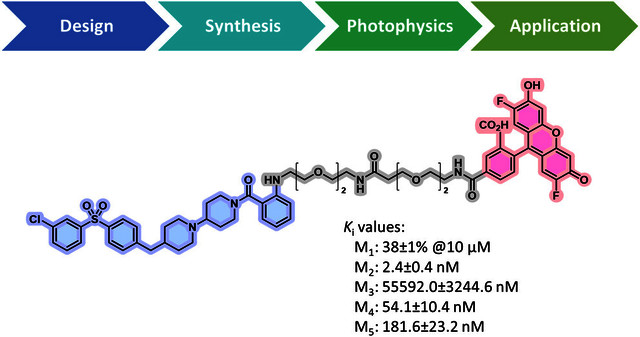
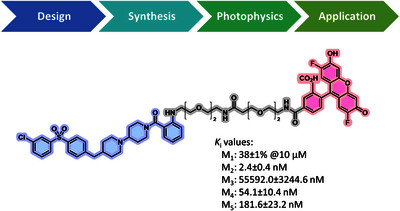
The M2 muscarinic acetylcholine receptor (M2R) is a G protein-coupled receptor involved in regulating cardiovascular functions and mediation of central muscarinic effects, such as movement, temperature control, and antinociceptive responses. Molecular probes targeting this receptor are therefore important in exploring its pathophysiological role at a molecular level. Herein, we report the design, synthesis, and evaluation of a new fluorescent probe for M2R based on an anthranilamide ligand. In radioligand binding experiments, the presented Oregon Green 488-labeled conjugate (33) exhibited high M2R affinity (Ki = 2.4 nM), a moderate preference for the M2R over the M4 receptor, and excellent to pronounced M2R selectivity compared to the M1, M3, and M5 receptors. The utility of the probe was demonstrated in confocal, two-photon, and stimulated emission depletion nanoscopy (STED) imaging to specifically label the receptors in human embryonic kidney (HEK) 293T cells. These properties suggest that our probe may be utilized in advanced microscopy to study the pharmacology of the M2R.
| Item Type: | Article |
|---|---|
| Additional Information: | Funding Agency and Grant Number: European Commission [RRF-2.3.1-21-2022-00015, 2020-1.1.2-PIACI-KFI-2020-00039, K 139231]; National Office of Research, Development and Innovation [PD143582]; OTKA Hungarian postdoctoral [NAP2022-I-2/2022 NAP 3.0]; Hungarian Academy of Sciences [NKFIH K137886]; Hungarian National Research, Development and Innovation Fund [2017-1.2.1-NKP-2017 00002]; Hungarian National Brain Research Program [ED431C 2022/20]; Xunta de Galicia [C2246513, KDP-IKT-2023-900-I1-00000957/0000003]; European Regional Development Fund (EDRF) [KDP-2023]; Ministry of Culture and Innovation of Hungary from the National Research, Development and Innovation fund Funding text: This work was supported by the following institutions/grants: National Office of Research, Development and Innovation (PharmaLab, RRF-2.3.1-21-2022-00015, 2020-1.1.2-PIACI-KFI-2020-00039, and K 139231, OTKA Hungarian postdoctoral grant PD143582), the Hungarian Academy of Sciences (NAP2022-I-2/2022 NAP 3.0), the Hungarian National Research, Development and Innovation Fund (NKFIH K137886), the Hungarian National Brain Research Program 2017-1.2.1-NKP-2017 00002, 3.0, and the FLAG-ERA Joint Transnational Call 2021, VIPattract grant and Xunta de Galicia (ED431C 2022/20), and European Regional Development Fund (EDRF). Project C2246513, KDP-IKT-2023-900-I1-00000957/0000003 has been implemented with the support provided by the Ministry of Culture and Innovation of Hungary from the National Research, Development and Innovation fund, financed under the KDP-2023 funding scheme. We thank Jozsef Simon for HRMS measurements as well as Krisztina Balazs for her contributions to the synthetic work. We thank Attila Lehotzky for his assistance with the BRET measurements. |
| Uncontrolled Keywords: | fluorescent probe, G protein-coupled receptor, imaging, two-photon microscopy, STED nanoscopy |
| Subjects: | Q Science / természettudomány > QD Chemistry / kémia |
| SWORD Depositor: | MTMT SWORD |
| Depositing User: | MTMT SWORD |
| Date Deposited: | 06 Apr 2026 07:51 |
| Last Modified: | 06 Apr 2026 07:51 |
| URI: | https://real.mtak.hu/id/eprint/236738 |
Actions (login required)
 |
Edit Item |