Kiss, Virág Viktória and Varga, Norbert and Juhász, Ádám and Seres, László and Csapó, Edit (2026) Influence of different production processes on the formation of asolectin-based colloids to improve quercetin and rutin formulation efficiency. JOURNAL OF MOLECULAR LIQUIDS, 453. No. 129530. ISSN 0167-7322
|
Text
1-s2.0-S0167732226003016-main.pdf - Published Version Available under License Creative Commons Attribution. Download (5MB) | Preview |
|
![[img]](https://real.mtak.hu/239187/7/1-s2.0-S0167732226003016-ga1_lrg.jpg)
|
Text (graphical abstract)
1-s2.0-S0167732226003016-ga1_lrg.jpg - Published Version Available under License Creative Commons Attribution. Download (289kB) | Preview |
Abstract
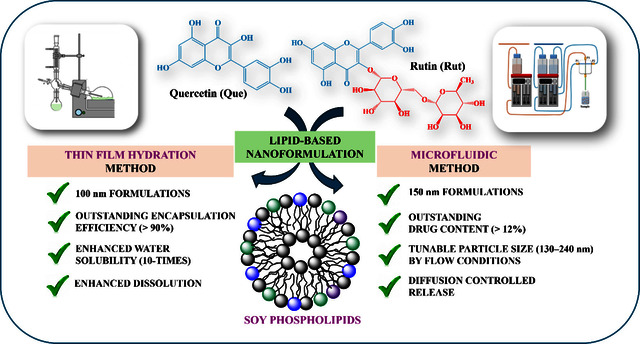
Poor stability and low bioavailability often hinder the application of flavonoids, despite their benefits. Integration of nanotechnology and flavonoid research has emerged as a cutting-edge approach to ensure the effective delivery and stabilization of these natural antioxidants. Lipid-based colloidal carriers are widely investigated for improving the solubility and bioavailability of bioactive compounds. In this work, quercetin (Que) and rutin (Rut), two structurally related flavonoids with distinct physicochemical properties, were encapsulated into asolectin (Aso)-based colloids using thin-film hydration, ethanol injection, and microfluidic preparation methods. The influence of formulation routes and drug-to-lipid mass ratios on particle size, ζ-potential, encapsulation efficiency (EE%), and drug loading (DL%) was systematically investigated. Formulations with hydrodynamic diameters below 150 nm and highly negative ζ-potentials were obtained for both flavonoid formulations, however, significant differences were observed in EE% and attainable DL%. Thin-film hydration was proved to be optimal for Que, yielding EE% > 90% and 10-fold increase in water solubility, while microfluidic preparation enabled dominantly higher DL% (∼12%) for Rut without precipitation. In vitro release studies demonstrated enhanced dissolution of Que upon formulation, whereas Rut release remained largely diffusion controlled. The results highlight the critical role of unique molecular features and independent preparation methods in determining the performance of lipid-based flavonoid-containing delivery systems.
| Item Type: | Article |
|---|---|
| Uncontrolled Keywords: | Lipid particles, Soy phospholipids, Flavonoids, Encapsulation capacity, Microfluidics, Drug release |
| Subjects: | Q Science / természettudomány > QD Chemistry / kémia R Medicine / orvostudomány > RM Therapeutics. Pharmacology / terápia, gyógyszertan |
| SWORD Depositor: | MTMT SWORD |
| Depositing User: | MTMT SWORD |
| Date Deposited: | 01 Jun 2026 11:27 |
| Last Modified: | 01 Jun 2026 11:27 |
| URI: | https://real.mtak.hu/id/eprint/239187 |
Actions (login required)
 |
Edit Item |