Székács, Inna and Novák, Szabolcs and Kovács, Boglárka and Dicső, Zoltán and Péter, Beatrix and Bonyár, Attila and Popov, Roman and Frutiger, Andreas and Horváth, Róbert (2026) Organization and Dynamics of Focal Adhesions: Light Diffraction Analysis of Cellular Adhesion on Nanopatterned Surfaces. ACS APPLIED MATERIALS & INTERFACES. ISSN 1944-8244 (In Press)
|
Text
organization-and-dynamics-of-focal-adhesions-light-diffraction-analysis-of-cellular-adhesion-on-nanopatterned-surfaces.pdf - Published Version Available under License Creative Commons Attribution. Download (14MB) | Preview |
|
![[img]](https://real.mtak.hu/239777/7/images_large_am6c04698_0007.jpeg)
|
Text (graphical abstract)
images_large_am6c04698_0007.jpeg - Published Version Available under License Creative Commons Attribution. Download (144kB) | Preview |
Abstract
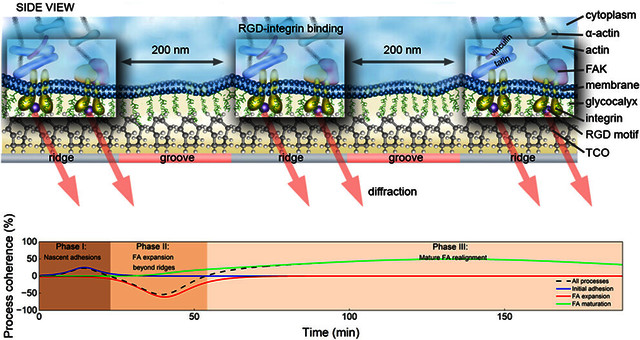
This study presents the first application of nanophotonic sensing modality for investigating live-cell adhesion, introducing a novel label-free optical method to monitor specific nanoscale structural changes at the cell−substrate interface. Our method utilizes receptor molecules immobilized in a diffraction pattern with a precise submicron periodicity, which provides superior sensing volume confinement through the spatial lock-in amplification principle. This internal nanoscale ruler enables the investigation of otherwise diffraction-limited phenomena with higher specificity and reduced background noise, ultimately providing more insight into nanoscale adhesion organization dynamics. To complement this approach, resonant waveguide grating (RWG) biosensing and holographic microscopy were used to characterize adhesion behavior and morphological changes of HeLa cells on RGD-functionalized substrates. The nanophotonic readout revealed distinct multistep adhesion dynamics associated with integrin clustering, nanoscale redistribution of adhesionassociated molecular assemblies, and focal adhesion remodeling. Quantitative analysis estimated that approximately 1.22 × 10⁶ RGD-specific integrins contributed to the coherent adhesion signal per HeLa cell within 2 h of adhesion, while the measured redistribution dynamics corresponded to an effective velocity of approximately 0.09 μm/h. Enzymatic digestion of the glycocalyx with neuraminidase significantly altered adhesion behavior, highlighting the importance of membrane organization in integrinmediated adhesion. Furthermore, histamine stimulation modulated adhesion dynamics and induced cytoskeleton-associated remodeling responses that depended on the prior adhesion time. Together, these results demonstrate the sensitivity of this diffraction-engineered sensing strategy to subtle mechanobiologically regulated changes in the cellular microenvironment and establish its potential as a powerful tool for real-time studies of the biophysical regulation of cell adhesion and receptor-mediated signaling.
| Item Type: | Article |
|---|---|
| Uncontrolled Keywords: | diffraction-based optical sensing, nanophotonic biosensor, label-free, live-cell adhesion, cell−substrate interactions |
| Subjects: | Q Science / természettudomány > QH Natural history / természetrajz > QH301 Biology / biológia |
| SWORD Depositor: | MTMT SWORD |
| Depositing User: | MTMT SWORD |
| Date Deposited: | 10 Jun 2026 12:23 |
| Last Modified: | 10 Jun 2026 12:23 |
| URI: | https://real.mtak.hu/id/eprint/239777 |
Actions (login required)
 |
Edit Item |