Török, Tímea Nóra and Kövecs, Roland and Braun, Ferenc and Pollner, Zsigmond and Zeffer, Tamás and Nguyen Quoc, Khánh and Pósa, László and Révész, Péter and Kim, Heungsoo and Piqué, Alberto and Halbritter, András and Volk, János (2026) Memristor-driven spike encoding for fully implantable cochlear implants. BIOMEDICAL SIGNAL PROCESSING AND CONTROL, 125. No. 110761. ISSN 1746-8094
|
Text
1-s2.0-S1746809426013157-main.pdf - Published Version Available under License Creative Commons Attribution. Download (2MB) | Preview |
|
![[img]](https://real.mtak.hu/239876/7/1-s2.0-S1746809426013157-ga1_lrg.jpg)
|
Text (graphical abstract)
1-s2.0-S1746809426013157-ga1_lrg.jpg - Published Version Available under License Creative Commons Attribution. Download (214kB) | Preview |
Abstract
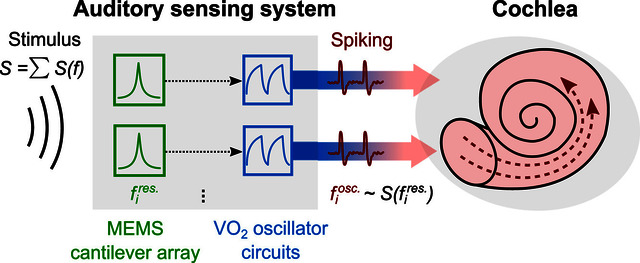
Neurodynamic behavior of artificial neuron circuits made of Mott memristors provides versatile opportunities to utilize them for artificial sensing. Their compactness and energy-efficient spike generation enable integration into medical implants. This work demonstrates a low-power, biomimetic auditory sensing concept for fully implantable cochlear implants. The approach draws inspiration from the frequency selectivity and temporal encoding of the cochlea, and uses neuromorphic spike generation to replace conventional signal processing blocks. The auditory sensing unit is realized by a piezoelectric MEMS cantilever coupled to a single VO nanogap Mott memristor-based oscillator. This configuration enables FFT-free, frequency-selective sensing and direct spike generation, forming a biomimetic auditory front end. The sensing unit exhibits frequency-selective detection of mechanical vibrations in the nanometer to tens-of-nanometers displacement range and generates biomimetic spiking waveforms. Spike rate-encoding of the input amplitude is demonstrated, with output spiking frequencies tunable between approximately 100 Hz and 1 kHz depending on the excitation level. The waveform is finally converted to a biphasic shape suitable for cochlear implant stimulation. Through realizing temporal spike-encoding, a fundamental principle in the healthy auditory pathway, the proposed approach can provide significant benefits for cochlear implants. In addition, the circuit has the potential to reduce footprint, energy consumption, and latencies compared to current commercial solutions.
| Item Type: | Article |
|---|---|
| Uncontrolled Keywords: | Action potential, Frequency resolved MEMS array, Nanogap memristor, Piezo-MEMS, Rate encoding, Tonotopy, VO2 |
| Subjects: | Q Science / természettudomány > Q1 Science (General) / természettudomány általában |
| SWORD Depositor: | MTMT SWORD |
| Depositing User: | MTMT SWORD |
| Date Deposited: | 15 Jun 2026 09:56 |
| Last Modified: | 15 Jun 2026 09:56 |
| URI: | https://real.mtak.hu/id/eprint/239876 |
Actions (login required)
 |
Edit Item |