Szabó, Yvette and Asher, Meerab and Zahorán, Réka and Papp, Judit and Sebők, Dániel and Sipos, Pál Miklós and Szabados, Márton and Gräfe, Markus and Kutus, Bence (2026) Effect of Amorphous Silicates on the Neutralization of Tricalcium Aluminate Hexahydrate Relevant to Bauxite Residue Treatment. INORGANIC CHEMISTRY, 65 (9). pp. 5178-5190. ISSN 0020-1669
|
Text
effect-of-amorphous-silicates-on-the-neutralization-of-tricalcium-aluminate-hexahydrate-relevant-to-bauxite-residue.pdf - Published Version Available under License Creative Commons Attribution. Download (4MB) | Preview |
|
![[img]](https://real.mtak.hu/239999/7/images_large_ic6c00005_0010.jpeg)
|
Text (graphical abstract)
images_large_ic6c00005_0010.jpeg - Published Version Available under License Creative Commons Attribution. Download (98kB) | Preview |
Abstract
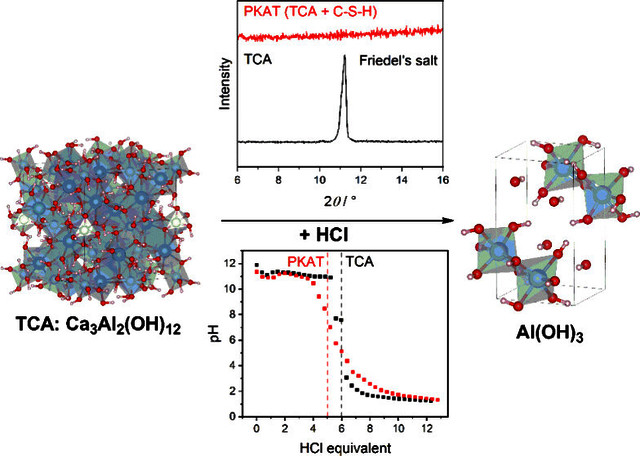
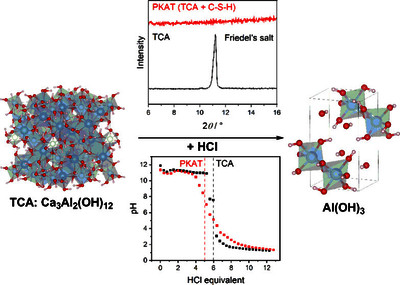
Acid neutralization is an efficient way to lower the solution pH of bauxite residue slurries (generated via the Bayer process) to a level that enables safe handling and further utilization. Tricalcium aluminate hexahydrate (TCA, Ca3Al2(OH)12) and its silicate-substituted polymorph, katoite (KAT, Ca3Al2(SiO4)x(OH)12–4x), are one of the major sources that contribute to the high alkalinity of residues. Yet, the neutralization chemistry of KAT phases is poorly understood. To this end, we synthesized TCA and KAT and studied their acid–base reactions. We find the as-prepared pseudo-KAT (PKAT) phase to be a poorly substituted TCA with x ≈ 0.05 while containing amorphous calcium silicate hydrate as well as sodium aluminosilicate minor phases. Upon addition of HCl, TCA first transforms to Friedel’s salt, a layered double hydroxide hosting Cl– ions, which is absent for PKAT. Further, the lack of LDH precipitation, closely related to calcium silicate hydrate, gives rise to a lower buffering range (by ∼0.5–1.2 pH units) for PKAT. Another striking consequence of minor silicate phases in PKAT is the ∼17% smaller acid consumption as compared to TCA. In conclusion, amorphous silicates markedly affect both the neutralization mechanism and capacity of tricalcium aluminate hydrates.
| Item Type: | Article |
|---|---|
| Subjects: | Q Science / természettudomány > QD Chemistry / kémia |
| SWORD Depositor: | MTMT SWORD |
| Depositing User: | MTMT SWORD |
| Date Deposited: | 15 Jun 2026 14:07 |
| Last Modified: | 15 Jun 2026 14:07 |
| URI: | https://real.mtak.hu/id/eprint/239999 |
Actions (login required)
 |
Edit Item |