Szabó, Yvette and Kutus, Bence and Mészáros, Rebeka Ildikó and Bélteky, Péter and Kónya, Zoltán and Kukovecz, Ákos and Sipos, Pál Miklós and Szabados, Márton (2027) Thermocatalytic transcarbonation with diethyl carbonate for valorization of glycerol : recycling siliceous bauxite residue waste components and exploring the potential of sodalite hydroxide reservoir. FUEL, 427. No. 139880. ISSN 0016-2361 (In Press)
|
Text
1-s2.0-S0016236126016340-main.pdf - Published Version Available under License Creative Commons Attribution Non-commercial No Derivatives. Download (6MB) | Preview |
|
![[img]](https://real.mtak.hu/240000/7/1-s2.0-S0016236126016340-ga1_lrg.jpg)
|
Text
1-s2.0-S0016236126016340-ga1_lrg.jpg - Published Version Available under License Creative Commons Attribution Non-commercial No Derivatives. Download (215kB) | Preview |
Abstract
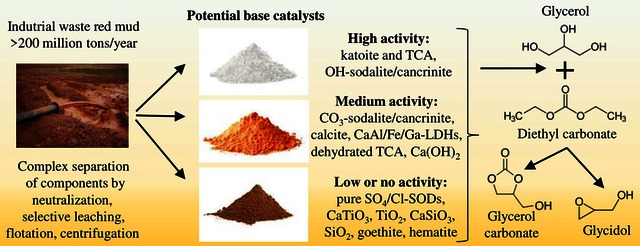
Bauxite residues contain katoites and desilication products (sodalite and cancrinite), which are excellent candidates for Earth-abundant heterogeneous base catalysts from industrial waste sources. For the first time, they were tested in synthetizing the renewable and promising fuel or fuel additive glycerol carbonate for the purpose of recycling glycerol by-products from biodiesel production. Incorporation of silicate was found to enhance the previously established excellent catalytic activity of tricalcium aluminate (Si-free katoite). Performance of sodalites containing four different cage anion-designed (OH, CO3, SO4, Cl) and carbonated cancrinite was determined to a much greater extent by their Brönsted OH content than by the basicity of the caged anions. Direct catalytic use of bauxite residue resulted in a glycerol carbonate yield of over 80%, but it was quickly deactivated due to the limited reusability of many of its most active components (i.e., Si-free and Si-containing katoites, chloride sodalites). However, hydroxysodalites showed excellent reusability, with a glycerol carbonate yield of around 80% even after 5 reuses. The activity of katoites and sodalities overtook that of many complex systems containing relatively rare metals, such as Ni, Cu, Zr, and Ce. Their excellent activity has made it possible to use diethyl carbonate solvent/reagent, which is more favourable in terms of sustainability, instead of the more widely applied dimethyl carbonate, even with as short reaction times as 30–60 min.
| Item Type: | Article |
|---|---|
| Uncontrolled Keywords: | Bauxite residues, Katoites, Sodalites, Earth-abundant catalysts, Glycerol carbonate production, Catalytic dominance of hydroxide cage anions |
| Subjects: | Q Science / természettudomány > QD Chemistry / kémia |
| SWORD Depositor: | MTMT SWORD |
| Depositing User: | MTMT SWORD |
| Date Deposited: | 15 Jun 2026 14:17 |
| Last Modified: | 15 Jun 2026 14:17 |
| URI: | https://real.mtak.hu/id/eprint/240000 |
Actions (login required)
 |
Edit Item |