Cseh, Martin and Hegedüs, Réka and Kovács, Anita and Berkó, Szilvia and Ambrus, Rita and Katona, Gábor and Pannonhalminé Csóka, Ildikó (2026) A novel rotation-based spray-coating method for modifying the release profile of immediate-release dissolving microneedle array cores. INTERNATIONAL JOURNAL OF PHARMACEUTICS, 701. No. 127175. ISSN 0378-5173 (In Press)
![[img]](https://real.mtak.hu/style/images/fileicons/text.png) |
Text
1-s2.0-S037851732600623X-main.pdf - Published Version Restricted to Registered users only Download (17MB) | Request a copy |
|
![[img]](https://real.mtak.hu/243232/7/gra.jpg)
|
Text (graphical abstract)
gra.jpg - Published Version Download (89kB) | Preview |
Abstract
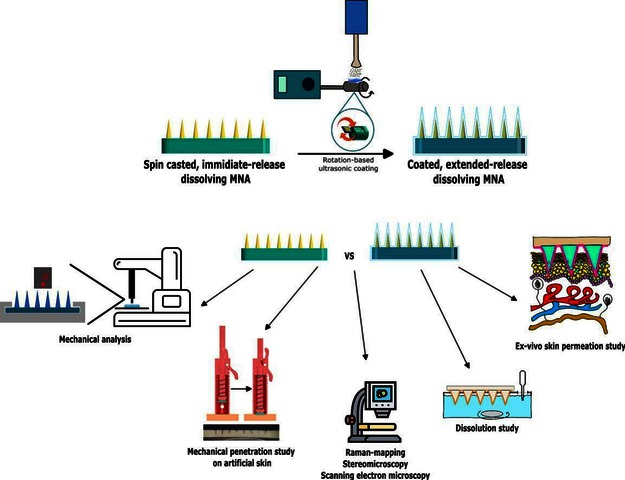
Microneedle arrays (MNAs) are typically created by attaching one or more pointed, submillimeter-sized objects to a suitable carrier. These therapeutic systems can effectively deliver poorly absorbed water-soluble active ingredients (such., peptides, proteins) into the systemic circulation by piercing the outermost, hard-to-penetrate skin layer, the Stratum corneum. By choosing the optimal needle length, the pain during application remains minimal compared to other invasive methods (e.g., transcutaneous or intracutaneous injection), which improves patient compliance. Although dissolving microneedles (DMNAs) are the most studied type because of their promising features, other types may face challenges in achieving an extended-release profile, depending on the circumstances and compatibility of different carriers and APIs. This work presents a new, efficient method for uniformly coated dissolving microneedle arrays containing fluorescein isothiocyanate-labelled bovine serum albumin (FITC-BSA), a model protein-based active ingredient, utilizing a novel rotation-based spray-coating technique. For the coating material of the DMNAs, the pH-independent methacrylate polymer, Eudragit RS, was used. Various microscopic and Raman mapping experiments demonstrated the coating’s uniformity, while texture analysis and mechanical penetration studies confirmed that the formulations successfully penetrate the skin. Dissolution and ex vivo permeation studies verified that the coating layer extends the sample’s release profile. Based on these findings, this innovative coating method could serve as a promising foundation for further research into producing extended-release or drug-in-coating MNAs.
| Item Type: | Article |
|---|---|
| Uncontrolled Keywords: | Dissolving microneedles; Spray-coating; Fluorescein isothiocyanate-labeled bovine serum albumin; Drug release studies; Ex vivo skin penetration; Polymer coated polymeric microneedle array |
| Subjects: | R Medicine / orvostudomány > RM Therapeutics. Pharmacology / terápia, gyógyszertan |
| SWORD Depositor: | MTMT SWORD |
| Depositing User: | MTMT SWORD |
| Date Deposited: | 27 Jul 2026 15:17 |
| Last Modified: | 27 Jul 2026 15:17 |
| URI: | https://real.mtak.hu/id/eprint/243232 |
Actions (login required)
 |
Edit Item |