Márton, Péter and Demény, Petra and Rácz, Adél Sarolta and Szabó, Tamás and Keresztes, Zsófia and Balterer, Bence and Madarász, János and Nagy, Norbert and Márton, Rita and Molnár, Mónika and Hórvölgyi, Zoltán (2026) CTAB-modified chitosan nanocoatings: Increasing the cationic surface character by self-assembly. INTERNATIONAL JOURNAL OF BIOLOGICAL MACROMOLECULES, 375. ISSN 0141-8130
|
Text
1-s2.0-S0141813026033568-main.pdf - Published Version Available under License Creative Commons Attribution Non-commercial No Derivatives. Download (5MB) | Preview |
|
![[img]](https://real.mtak.hu/243715/7/1-s2.0-S0141813026033568-ga1_lrg.jpg)
|
Text (graphical abstract)
1-s2.0-S0141813026033568-ga1_lrg.jpg - Published Version Available under License Creative Commons Attribution Non-commercial No Derivatives. Download (98kB) | Preview |
Abstract
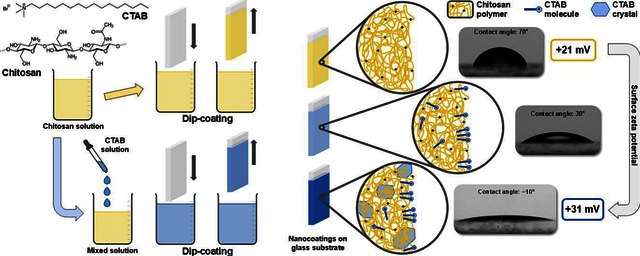
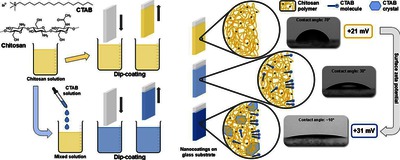
Cetyltrimethylammonium bromide (CTAB)-containing chitosan nanolayers were deposited onto glass substrates via dip-coating from aqueous precursor solutions with 1% chitosan and 0–3.0 mM CTAB content. The thickness of the coatings was ca. 200–300 nm, according to UV–visible spectroscopy. While lower surfactant concentrations (0.25–1.0 mM) resulted in homogeneous, semicrystalline coatings, AFM, X-ray diffraction and solid-state NMR evidenced phase separation and the formation of CTAB crystallites in the case of the samples made from precursor solutions with over 1.0 mM CTAB concentration. X-ray photoelectron spectroscopy confirmed a significant interfacial accumulation of CTAB on the coating-air interface (up to eightfold increase in quaternary N), while contact angle measurements indicated an increase in hydrophilicity, with advancing water contact angles decreasing from 70° to ca. 30°, with increasing Lewis-basic surface free energy component. Crucially, surface zeta potential measurements demonstrated an increase in positive surface charge from +22 mV to over +30 mV, and turbidimetric and colorimetric assays confirmed the antibacterial effect (over 80% inhibition) of the coatings against B. subtilis. These findings suggest the formation of a unique molecular structure, where the CTAB was accumulated on the surface of the nanolayer with outward-oriented cationic head groups, providing a robust strategy for developing enhanced antimicrobial coatings.
| Item Type: | Article |
|---|---|
| Uncontrolled Keywords: | Chitosan; Nanocoating; Cetyltrimethylammonium bromide; Polymer-surfactant interactions; Cationic surface character |
| Subjects: | T Technology / alkalmazott, műszaki tudományok > T2 Technology (General) / műszaki tudományok általában |
| SWORD Depositor: | MTMT SWORD |
| Depositing User: | MTMT SWORD |
| Date Deposited: | 03 Aug 2026 08:40 |
| Last Modified: | 03 Aug 2026 08:40 |
| URI: | https://real.mtak.hu/id/eprint/243715 |
Actions (login required)
 |
Edit Item |