Almássy, Boglárka and Balázsi, Katalin and Balázsi, Csaba (2026) Preparation and Characterization of Hydroxyapatite from Eggshells via a Basic Route Using Attritor Milling. NANOMATERIALS, 16 (15). No. 899. ISSN 2079-4991
|
Text
nanomaterials-16-008991.pdf - Published Version Available under License Creative Commons Attribution. Download (1MB) | Preview |
|
![[img]](https://real.mtak.hu/243716/7/nanomaterials-16-00899-ag.png)
|
Text (graphical abstract)
nanomaterials-16-00899-ag.png - Published Version Available under License Creative Commons Attribution. Download (4MB) | Preview |
Abstract
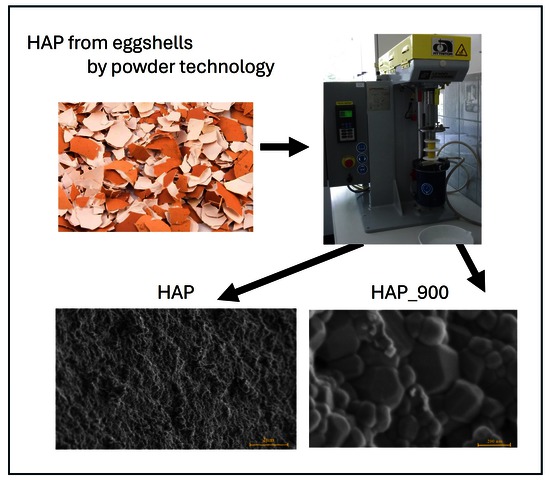
In this study, pure hydroxyapatite (HAp) was successfully produced by using eggshells. The eggshells were collected locally and calcined to get CaO from them. The CaO powder was reacted with diammonium hydrogen phosphate in a mechanochemical method using attritor milling. A portion of the synthesized samples was subjected to a second calcination process at 900 °C to investigate the thermal effects on the material. The structures of the samples were investigated by scanning electron microscopy, X-ray diffraction, and infrared spectroscopy. The as-prepared HAp appeared to be nanocrystalline with low-intensity reflections, which transformed into a highly crystalline hexagonal phase after heat treatment, as revealed by XRD analysis. Quantitative analysis revealed the thermal evolution of the secondary Ca(OH)2 phase, due to the thermal decomposition into CaO without causing HAp decomposition into tricalcium phosphates. FTIR analysis showed characteristic phosphate bands for both samples, but the calcined sample displayed sharper peaks and a clear loss of residual water and carbonates. SEM observations also highlighted the major morphological transformation. The highly aggregated as-prepared nanoparticles formed larger, well-defined grains. Notably, the calcined sample also exhibited a rough, textured surface with a macroporous network with interconnected channels. EDS analysis confirmed a Ca-P-O-rich composition, where the elevated Ca/P ratio (Ca/P = 2.28) suggested the presence of secondary calcium-rich phases. These structural, chemical, and morphological characteristics suggest that eggshell-derived HAp, with or without a second heat treatment, has high potential and may be optimized for different applications in bone tissue engineering. However, biological performance was not evaluated in this study.
| Item Type: | Article |
|---|---|
| Uncontrolled Keywords: | eggshell; attrition milling; basic route; bone graft |
| Subjects: | T Technology / alkalmazott, műszaki tudományok > T2 Technology (General) / műszaki tudományok általában |
| SWORD Depositor: | MTMT SWORD |
| Depositing User: | MTMT SWORD |
| Date Deposited: | 03 Aug 2026 09:48 |
| Last Modified: | 03 Aug 2026 09:48 |
| URI: | https://real.mtak.hu/id/eprint/243716 |
Actions (login required)
 |
Edit Item |