Mohammad, Hanan and Darwish, Maher and Katona, Gábor and Csóka, Ildikó (2026) Albumin surface and interface engineering of non-albumin nanoparticles in cancer nanomedicine: A critical review. BIOMEDICINE & PHARMACOTHERAPY, 203. No. 119907. ISSN 0753-3322
|
Text
1-s2.0-S0753332226009431-main_compressed.pdf - Published Version Available under License Creative Commons Attribution Non-commercial. Download (1MB) | Preview |
|
![[img]](https://real.mtak.hu/245547/7/1-s2.0-S0753332226009431-ga1_lrg.jpg)
|
Text (graphical abstract)
1-s2.0-S0753332226009431-ga1_lrg.jpg - Published Version Available under License Creative Commons Attribution Non-commercial. Download (317kB) | Preview |
Abstract
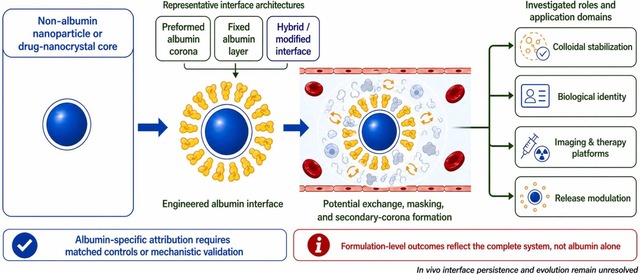
Engineered albumin interfaces can modify the biological identity and performance of non-albumin nanoparticles in cancer nanomedicine, but their independent contribution is often obscured by multicomponent designs. This critical review evaluates studies in which albumin or an albumin-derived construct was deliberately positioned at the outer interface of a non-albumin nanoparticle or drug nanocrystal before biological exposure. Architectures included adsorbed layers, covalent or crosslinked coatings, albumin-stabilized nanocrystal interfaces, and hybrid or modified constructs. Across 35 primary studies, albumin served mainly as a stabilizing, cargo-binding, release-modulating, ligand-bearing, or biologically active interfacial component. Matched controls supported selected albumin-associated changes in colloidal stability, cellular interaction, tumor drug delivery, macrophage uptake, and secondary-corona composition. By contrast, imaging, photothermal and radiation responses, pharmacokinetics, biodistribution, and antitumor efficacy often depended on the nanoparticle core, payload, targeting ligand, other surface components, or applied energy and therefore generally represent formulation-level outcomes unless albumin was specifically isolated. Secondary-corona studies suggest that engineered albumin interfaces may reshape corona composition rather than suppress protein adsorption, but the biological consequences remain incompletely resolved. The persistence and conformational accessibility of manufactured albumin interfaces during circulation are also poorly defined, and proposed receptor-mediated mechanisms rarely have direct support. Corona-proteomic findings remain hypothesis-generating and have not established clinically validated cancer detection or diagnostic performance. Future translation requires matched albumin-free and protein-replacement controls, independent in vivo tracking of nanoparticle cores and albumin interfaces, standardized secondary-corona characterization, pharmacokinetic and safety evaluation, and validation of promising bovine serum albumin (BSA)-based systems using clinically relevant human serum albumin (HSA) interfaces.
| Item Type: | Article |
|---|---|
| Additional Information: | This work was supported by János Bolyai Research Scholarship of the Hungarian Academy of Sciences (BO/00043/25). |
| Uncontrolled Keywords: | Albumin surface engineering, Albumin-coated nanoparticles, Cancer nanomedicine, Controlled drug release, Protein corona, Corona proteomics |
| Subjects: | R Medicine / orvostudomány > RM Therapeutics. Pharmacology / terápia, gyógyszertan |
| SWORD Depositor: | MTMT SWORD |
| Depositing User: | MTMT SWORD |
| Date Deposited: | 04 Sep 2026 11:48 |
| Last Modified: | 04 Sep 2026 11:48 |
| URI: | https://real.mtak.hu/id/eprint/245547 |
Actions (login required)
 |
View Item |