Bocz, Csenge and Adamecz, Dóra Izabella and Szőke, Krisztina and Péntek, Bálint and Szabó, Emilia Rita and Polanek, Róbert and Szögi, Titanilla and Rónavári, Andrea and Hideghéty, Katalin and Kónya, Zoltán and Igaz, Nóra and Csontné Kiricsi, Mónika (2026) Multimodal radiosensitization by hafnium oxide nanoparticles and HDAC inhibitors: mechanistic insights. NANOSCALE ADVANCES, 8 (6). pp. 2003-2020. ISSN 2516-0230
|
Text
Bocz_NanoscaleAdvances_Bolyaiosztondij.pdf - Published Version Available under License Creative Commons Attribution Non-commercial. Download (7MB) | Preview |
|
![[img]](https://real.mtak.hu/246090/7/d5na00845j-ga.png)
|
Text (graphical abstract)
d5na00845j-ga.png - Published Version Available under License Creative Commons Attribution Non-commercial. Download (567kB) | Preview |
Abstract
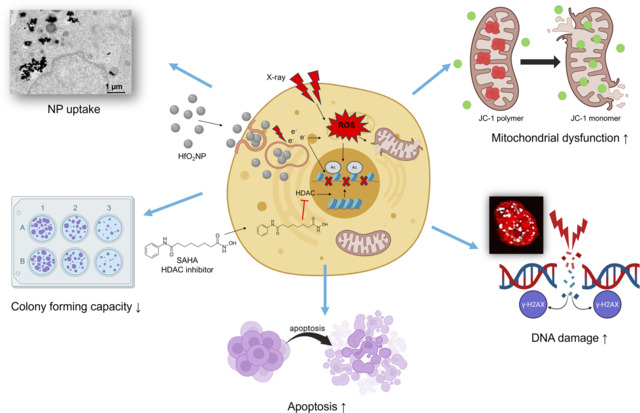
Radiation therapy is routinely utilized in cancer treatment, often in combination with chemotherapy, but is limited by collateral damage to healthy tissues and radioresistance of some tumors. Radiosensitizing agents can enhance tumor cell susceptibility to ionizing radiation, allowing effective treatment at lower doses. High-atomic-number metal-based nanoparticles, such as hafnium oxide (HfO2NP), can locally amplify the impact of ionizing radiation on cancer cells, augment the radiation-triggered generation of reactive electrons and oxygen species (ROS), induce DNA damage, and ultimately lead to cell death. We hypothesized that this effect can be further enhanced by histone deacetylase (HDAC) inhibitors, which maintain the chromatin in a relaxed state and render the DNA more accessible to genotoxic stress. In this study, we found that HfO2NPs and the HDAC inhibitor, when combined with irradiation, induced significantly higher ROS production, massively reduced mitochondrial membrane potential, and increased DNA double-strand break formation in cancer cells compared to untreated or single-agent-treated cells. These effects led to a marked reduction in colony-forming potential in both 2D and 3D models and induced significant apoptosis. No cytotoxicity was observed in non-cancerous fibroblasts. HfO2NPs and the tested HDAC inhibitor form a remarkably efficient cancer-selective radiosensitizing combination, where the enzyme inhibitor facilitates the irradiation-induced DNA-damaging potential of the nanoparticles. This outstanding multimodal approach can target radioresistant cancer cells, while not affecting healthy cells, underscoring its potential in a next-generation nanomedicine-based radiosensitizing strategy to attenuate cancer cell growth for an improved therapeutic outcome.
| Item Type: | Article |
|---|---|
| Additional Information: | Funding Agency and Grant Number: Szegedi Tudomnyegyetem [Unassigned]; Emberi Eroforrsok Minisztriuma [NKP-22-5-SZTE-553, NKP-23-5-SZTE-680]; Magyarorszg Kormnya [OTKA-NKFIH (PD143320)]; Magyar Tudomnyos Akadmia [BO/00351/22/8]; European Regional Development Fund [Unassigned]; Nemzeti Kutatsi Fejlesztsi s Innovcis Hivatal [OTKA K142371] Funding text: The project was supported by the Incubation Competence Centre of the Centre of Excellence for Interdisciplinary Research, Development and Innovation of the University of Szeged (N. I. is the member of Molecular mechanisms of nanoparticle-induced radiosensitization research group) and the OTKA-NKFIH (K142371) and OTKA-NKFIH (PD143320) grants from the National Research, Development, and Innovation Office of the Hungarian Government. N. I. was supported by the Janos Bolyai Research Fellowship of the Hungarian Academy of Sciences (BO/00351/22/8), by the New National Excellence Program of the Ministry of Human Capacities of Hungary (UNKP-22-5-SZTE-553 and UNKP-23-5-SZTE-680), and by the University Research Scholarship Program of the Ministry for Culture and Innovation from the source of the National Research, Development and Innovation Fund (EKOP-24-4-SZTE-626 for N. I.). D. A. was supported by the NTP-NFTO-22-B-0100 and NTP-NFTO-21-B-0157 grants of the National Excellence Program of the Ministry of Human Resources. The samples were irradiated in ELI-ALPS. ELI ALPS project (GINOP-2.3.6-15-2015-00001) is supported by the European Union and co-financed by the European Regional Development Fund. |
| Subjects: | R Medicine / orvostudomány > RC Internal medicine / belgyógyászat > RC0254 Neoplasms. Tumors. Oncology (including Cancer) / daganatok, tumorok, onkológia |
| SWORD Depositor: | MTMT SWORD |
| Depositing User: | MTMT SWORD |
| Date Deposited: | 14 Sep 2026 06:35 |
| Last Modified: | 14 Sep 2026 06:35 |
| URI: | https://real.mtak.hu/id/eprint/246090 |
Actions (login required)
 |
View Item |