Halpern, Bálint and Horváth, Gergely and Szövényi, Gergely and Herczeg, Gábor (2026) Negligible behavioural variation in Hungarian meadow vipers (Vipera ursinii rakosiensis) captive-reared intensively and the effects of simple environmental enrichment. APPLIED ANIMAL BEHAVIOUR SCIENCE, 304. No. 107162. ISSN 0168-1591
|
Text
Halpern et al. 2026_Appl Anim Behav Sci_Negligible behavioural variation in Hungarian meadow vipers (Vipera ursinii rakosiensis) captive-reared intensively and the effects of simple environmental enrichment.pdf - Published Version Available under License Creative Commons Attribution Non-commercial No Derivatives. Download (2MB) | Preview |
|
![[img]](https://real.mtak.hu/246207/2/1-s2.0-S0168159126002546-ga1_lrg.jpg)
|
Text (graphical abstract)
1-s2.0-S0168159126002546-ga1_lrg.jpg - Published Version Available under License Creative Commons Attribution Non-commercial No Derivatives. Download (295kB) | Preview |
Abstract
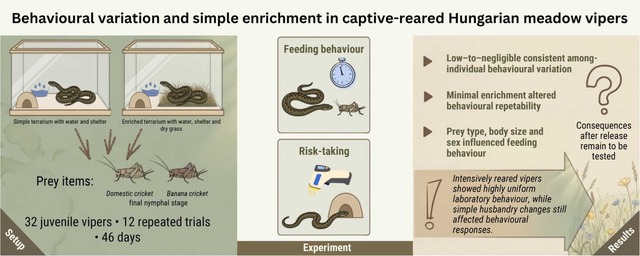
Captive breeding and reintroduction are typically seen as a last resort to save a certain taxon or population from going extinct. However, it is hard to decide between intensive (maximum growth, high number of individuals, lack of environmental experience) or quasi-natural extensive rearing (decreased growth, less individuals, more environmental experience) strategies. As behaviour is the first mean to cope with the unpredictable challenges (predation risk, finding food, optimal microhabitat or refuge) met upon release, standing behavioural variation between individuals before release is a key to success. Here, we studied between-individual behavioural variation (animal personality) in captive-bred Hungarian meadow vipers (Vipera ursinii rakosiensis; Europe’s most endangered venomous snake) under the most intensive rearing method (individual housing in small terraria, food ad libitum, no wintering) together with the effects of a simple abiotic (adding a clump of dried grass) environmental enrichment. We assessed their feeding (two prey types: banana cricket, Gryllus assimilis, house cricket, Acheta domesticus) and risk-taking behaviours 12–12 times over 46 days. G. assimilis and A. domesticus differed in their antipredator behaviour: G. assimilis stops more and for longer durations in a new potentially risky environment and hops less and freezes for longer durations after a simulated predatory attack than A. domesticus. Regarding the vipers, we found low to negligible between-individual behavioural variation. Enrichment canalised risk-taking and diversified swallowing time. Risk-taking increased with size. Feeding success was affected by an enrichment × size interaction: body size had a positive effect, but only in the absence of enrichment. Female vipers struck on A. domesticus faster than on G. assimilis, while males did not differentiate. Males struck more times and swallowed longer than females. We conclude that the low behavioural variation observed under the studied intensive rearing protocol may limit the range of behavioural responses available to vipers when encountering novel conditions after release, although the consequences for field performance remain to be tested. However, we also found that already minor environmental enrichment or prey type can affect the snakes’ behaviour. Future studies are needed to establish the critical environmental factors and the enrichment strategy (e.g. during whole development or for some period before release), which would increase behavioural variation sufficiently with minimised logistical costs for optimising the captive breeding and reintroduction strategy.
| Item Type: | Article |
|---|---|
| Uncontrolled Keywords: | Headstarting; Hungarian meadow viper; Vipera ursinii rakosiensis; Captive breeding; Behaviour |
| Subjects: | Q Science / természettudomány > QL Zoology / állattan > QL750-QL782.5 Animal behavior / etológia, állat-viselkedéstan |
| Depositing User: | dr Gergely Horváth |
| Date Deposited: | 14 Sep 2026 09:58 |
| Last Modified: | 14 Sep 2026 09:58 |
| URI: | https://real.mtak.hu/id/eprint/246207 |
Actions (login required)
 |
View Item |