Császár, Zsófia and Nagy, Márta and Gömöry, Ágnes and Kovács, Margit and Bényei, Attila C. and Bakos, József and Farkas, Gergely (2026) Amine substitution pattern governs catalytic performance in manganese-PNN ketone hydrogenation. MOLECULAR CATALYSIS, 601. No. 116139. ISSN 2468-8231
|
Text
1-s2.0-S2468823126004360-main.pdf - Published Version Available under License Creative Commons Attribution Non-commercial No Derivatives. Download (1MB) | Preview |
|
![[img]](https://real.mtak.hu/246254/2/1-s2.0-S2468823126004360-ga1_lrg.jpg)
|
Text (graphical abstract)
1-s2.0-S2468823126004360-ga1_lrg.jpg - Published Version Available under License Creative Commons Attribution Non-commercial No Derivatives. Download (370kB) | Preview |
Abstract
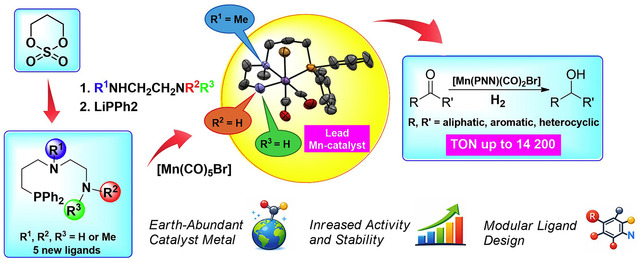
A highly modular synthetic strategy based on the ring opening of propane-1,3-diol cyclic sulfate by the corresponding diamines enabled the straightforward preparation of potentially tridentate phosphine-diamine (PNN) ligands of the general formula Ph2P(CH2)3N(R1)(CH2)2NR2R3 (R1, R2, R3 = H or CH3), featuring amine functionalities with different substitution patterns. Using these novel ligands, manganese(I) complexes of the type [Mn(PNN)(CO)2Br], incorporating the catalytically critical NH subunits in distinct chemical environments, were synthesized and evaluated in the hydrogenation of various ketones under different reaction conditions. Catalysts containing a terminal NH2 unit exhibited significantly higher activity than those bearing NHCH3 or N(CH3)2 moieties. Despite the expected reduction in ligand-metal cooperativity upon N-methylation, the presence of an internal N-methyl group in addition to the terminal amino functionality further enhanced catalytic performance. Density functional theory (DFT) calculations revealed substantial differences in the coordination stereochemistry of the PNN ligands within the catalytically active manganese hydride complexes, which correlate with the observed reactivity trends. The most active catalyst displayed exceptionally high turnover number among PNN-containing manganese complexes in ketone hydrogenation.
| Item Type: | Article |
|---|---|
| Additional Information: | University of Pannonia, Research Group of Organic Chemistry – Synthesis and Catalysis, Egyetem u. 10, Veszprém, H-8200, Hungary MS Proteomics Research Group, HUN-REN Research Centre for Natural Sciences, Magyar Tudósok körútja 2, Budapest, H-1117, Hungary NMR Laboratory, University of Pannonia, Egyetem u. 10, Veszprém, H-8200, Hungary University of Debrecen, Department of Physical Chemistry, Egyetem tér 1, Debrecen, H-4032, Hungary Export Date: 16 August 2026; Cited By: 0; Correspondence Address: G. Farkas; University of Pannonia, Research Group of Organic Chemistry – Synthesis and Catalysis, Veszprém, Egyetem u. 10, H-8200, Hungary; email: farkas.gergely@mk.uni-pannon.hu; CODEN: MCOAD |
| Uncontrolled Keywords: | Homogeneous catalysis; Manganese pincer complexes; Metal-ligand cooperation; Structure-activity relationship; Ligand design |
| Subjects: | Q Science / természettudomány > QD Chemistry / kémia |
| SWORD Depositor: | MTMT SWORD |
| Depositing User: | MTMT SWORD |
| Date Deposited: | 15 Sep 2026 06:49 |
| Last Modified: | 15 Sep 2026 06:49 |
| URI: | https://real.mtak.hu/id/eprint/246254 |
Actions (login required)
 |
View Item |