Adila, Nazli and Szögi-Tatár, Bernadett and Bősze, Szilvia and Tóth, Gergő and Solymosi, Katalin and Béni, Szabolcs and Boldizsár, Imre (2026) Aqueous Incubation Reveals Transformation of Rosmarinic Acid in Medicinally Important Nepetoideae Species and Leads to Novel Bioactive Compounds. PHARMACEUTICS, 18 (8). No. 1043. ISSN 1999-4923
|
Text
pharmaceutics-18-01043.pdf - Published Version Available under License Creative Commons Attribution. Download (2MB) | Preview |
|
![[img]](https://real.mtak.hu/246376/2/pharmaceutics-18-01043-ag.png)
|
Text
pharmaceutics-18-01043-ag.png - Published Version Available under License Creative Commons Attribution. Download (92kB) | Preview |
Abstract
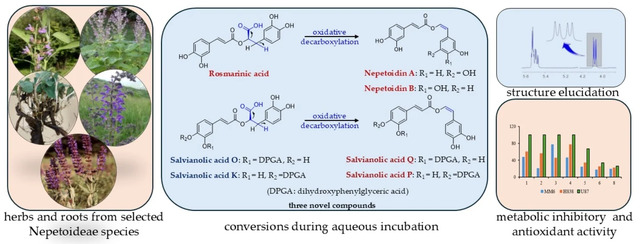
Background: Rosmarinic acid (RA) is a major phenylpropanoid constituent of many medicinal plants belonging to the Nepetoideae subfamily of the Lamiaceae family and contributes significantly to their biological activities. Traditionally, RA-containing extracts have been prepared using organic solvents or hot-water extraction. Methods: In addition to conventional extraction techniques, the phenylpropanoid composition of medicinally important tissues from 13 Nepetoideae species was investigated following incubation in an aqueous medium at room temperature. Phenylpropanoids in the differently prepared extracts were identified by extensive HPLC-UV-HR-MS/MS and NMR analyses. The antioxidant and cytostatic activities of isolated phenylpropanoids were evaluated using DPPH and Alamar Blue assays, respectively. Results: In tissues of all investigated species, RA underwent rapid enzyme-catalyzed conversion during aqueous incubation through oxidative decarboxylation, accompanied by the transient accumulation of nepetoidins A and B. The RA-related phenylpropanoid salvianolic acid K was identified in the roots of three Salvia species, while a previously undescribed isomer, designated salvianolic acid O, was discovered in the roots of Salvia verticillata. Both compounds underwent enzymatic transformations analogous to those of RA in aqueous medium, yielding two previously undescribed phenylpropanoids, salvianolic acids P and Q. Optimized aqueous incubation conditions enabled the high-yield accumulation of these conversion products. Together with their parent compounds, seven phenylpropanoids were isolated from selected plant tissues and were found to exhibit structure-dependent antioxidant and metabolic inhibitory activities in vitro. Conclusions: Aqueous incubation of Nepetoideae plant tissues markedly alters their phytochemical composition and provides access to previously unavailable bioactive phenylpropanoids.
| Item Type: | Article |
|---|---|
| Uncontrolled Keywords: | antioxidant; cytostatic; Mentha; Nepetoideae; nepetoidin; rosmarinic acid; Salvia; salvianolic acid |
| Subjects: | Q Science / természettudomány > QD Chemistry / kémia > QD01 Analytical chemistry / analitikai kémia |
| Depositing User: | Dr. Gergő Tóth |
| Date Deposited: | 15 Sep 2026 13:40 |
| Last Modified: | 15 Sep 2026 13:40 |
| URI: | https://real.mtak.hu/id/eprint/246376 |
Actions (login required)
 |
View Item |