Jánoska, Ádám and Szabó, Zoltán-István and Szőcs, Levente and Fiser, Béla and Tóth, Gergő (2026) Physicochemical characterization, cyclodextrin complexation, and protonation state-dependent receptor binding of selected tyrosine kinase inhibitors. JOURNAL OF MOLECULAR STRUCTURE, 1352 (1). No. 144518. ISSN 0022-2860
![[img]](https://real.mtak.hu/style/images/fileicons/text.png) |
Text
1-s2.0-S002228602503162X-main.pdf - Published Version Restricted to Registered users only Download (2MB) |
|
![[img]](https://real.mtak.hu/246415/2/1-s2.0-S002228602503162X-ga1_lrg.jpg)
|
Text (graphical abstract)
1-s2.0-S002228602503162X-ga1_lrg.jpg - Published Version Download (132kB) | Preview |
Abstract
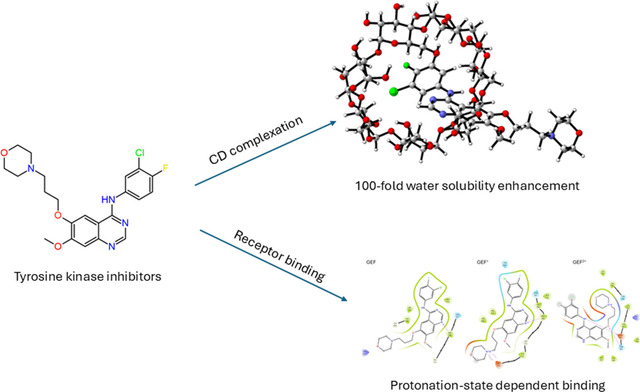
The comprehensive physicochemical characterization and cyclodextrin complexation of four tyrosine kinase inhibitors — erlotinib, gefitinib, vandetanib, and lapatinib — were studied using a suite of advanced analytical techniques. Determination of the acid-base properties, lipophilicity, and solubility of the four drugs highlighted that low solubility is a key factor limiting the bioavailability of these drugs. Protonation of the quinazoline ring was identified as essential for receptor binding, as demonstrated by molecular docking studies of protonation state-dependent interactions. Cyclodextrin complexation presents a promising approach to enhance the solubility of tyrosine kinase inhibitors. Thus, in-depth characterization of cyclodextrin complexation of these anticancer drugs using state-of-the-art analytical methods is crucial. Phase solubility studies indicated that the cavity size of β-cyclodextrin (β-CD) is particularly well-suited for the incorporation of these molecules. Among the modified β-CDs tested — randomly methylated, hydroxypropylated, and sulfobutylated β-CD — sulfobutylated β-CD conferred the greatest solubility enhancement, increasing solubility for each compound, providing an opportunity to develop a novel injection-based formulation. The inclusion complexes exhibit a 1:1 stoichiometry in all cases, confirmed by NMR Job plot titration. Additionally, 2D ROESY NMR spectroscopy and molecular modeling provided atomic-level structural insights into the structures of the complexes. Our research findings contribute to a better understanding of the pharmacokinetics and receptor binding of tyrosine kinase inhibitors, while also paving the way for the development of new, modern pharmaceutical formulations.
| Item Type: | Article |
|---|---|
| Uncontrolled Keywords: | Cyclodextrin, EGFR, NMR, Molecular modeling, Docking, Receptor binding |
| Subjects: | Q Science / természettudomány > QD Chemistry / kémia > QD01 Analytical chemistry / analitikai kémia |
| Depositing User: | Dr. Gergő Tóth |
| Date Deposited: | 16 Sep 2026 06:41 |
| Last Modified: | 16 Sep 2026 06:41 |
| URI: | https://real.mtak.hu/id/eprint/246415 |
Actions (login required)
 |
View Item |