Marcão, Sofia and Côrte-Real, Leonor and Alborghetti, Alice and Dejoux, Maël and Spengler, Gabriella and Fontrodona, Xavier and Romero, Isabel and Enyedy, Éva Anna and Antunes, Alexandra M. M. and Correia, Isabel (2026) Ni(II) Complexes of 2-Imine-8-Hydroxyquinolines: Characterization, Albumin Binding and Cytotoxicity. INORGANICS, 14 (9). No.239. ISSN 2304-6740
|
Text
inorganics-14-00239.pdf - Published Version Available under License Creative Commons Attribution. Download (1MB) | Preview |
|
![[img]](https://real.mtak.hu/246508/2/inorganics-14-00239-ag.png)
|
Text
inorganics-14-00239-ag.png - Published Version Available under License Creative Commons Attribution. Download (62kB) | Preview |
Abstract
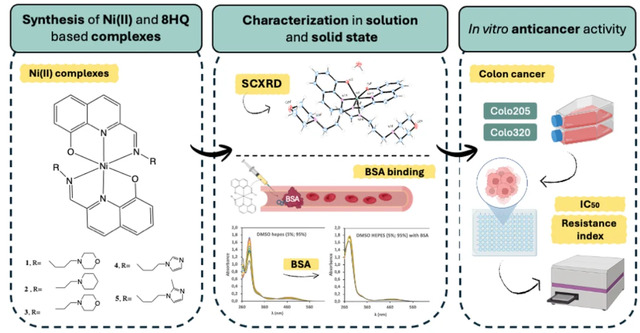
Nickel(II) offers an appealing base for metallodrug design as it is abundant, inexpensive and forms well-defined complexes with N,O-donor ligands. Therefore, five Ni(II) complexes containing two tridentate 2-imine-8-hydroxyquinoline Schiff base ligands, derived from morpholine, piperidine, imidazole or 2-methyl-1H-limidazole, were synthesized and characterized in solution and solid state via analytical and spectroscopic techniques. Single crystals were solved using X-ray diffraction for the complex derived from 4-(2-aminopropyl)morpholine (1). This Ni(II) complex exhibits a distorted octahedrally coordinated Ni(II) center bound to two monodeprotonated NNO-tridentate ligands, adopting a meridional coordination mode, with the two oxygen atoms arranged cis to each other. The stability of the complexes in aqueous media buffered at pH 7.4 was evaluated with UV–Vis spectroscopy and their binding to bovine serum albumin (BSA) was assessed with fluorescence titrations. All complexes show strong reversible binding to BSA (KSV ~105), which stabilizes the lipophilic complexes in aqueous media. The antiproliferative activity of the complexes was screened against colon cancer cell lines (Colo205 and Colo320). They exhibit moderate anticancer activity (IC50 = 15.1–92.5 μM), with structure–activity relationships favoring imidazole derivatives and maintaining activity against the doxorubicin-resistant cell line (Colo320) with resistance indices (1.3–3.1) comparable to or lower than doxorubicin. Overall, the complexes represent a platform to develop new anticancer Ni-based drugs.
| Item Type: | Article |
|---|---|
| Uncontrolled Keywords: | Nickel(II); 8-hydroxyquinoline; Schiff bases; albumin binding; colon cancer |
| Subjects: | R Medicine / orvostudomány > RM Therapeutics. Pharmacology / terápia, gyógyszertan |
| SWORD Depositor: | MTMT SWORD |
| Depositing User: | MTMT SWORD |
| Date Deposited: | 16 Sep 2026 12:56 |
| Last Modified: | 16 Sep 2026 12:57 |
| URI: | https://real.mtak.hu/id/eprint/246508 |
Actions (login required)
 |
View Item |