Menyhárt, Otília and Győrffy, Balázs (2024) Dietary approaches for exploiting metabolic vulnerabilities in cancer. BIOCHIMICA ET BIOPHYSICA ACTA-REVIEWS ON CANCER, 1879 (2). No. 189062. ISSN 0304-419X
|
Text
dietary.pdf - Published Version Available under License Creative Commons Attribution. Download (2MB) | Preview |
|
![[img]](https://real.mtak.hu/246677/7/1-s2.0-S0304419X23002111-ga1_lrg.jpg)
|
Text (graphical abstract)
1-s2.0-S0304419X23002111-ga1_lrg.jpg - Published Version Available under License Creative Commons Attribution. Download (175kB) | Preview |
Abstract
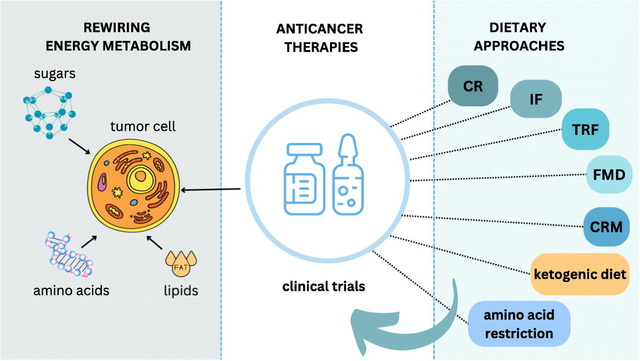
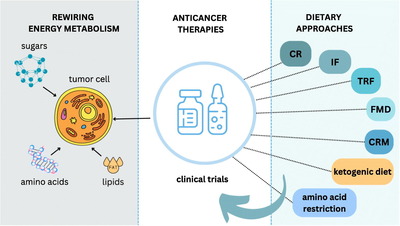
Renewed interest in tumor metabolism sparked an enthusiasm for dietary interventions to prevent and treat cancer. Changes in diet impact circulating nutrient levels in the plasma and the tumor microenvironment, and preclinical studies suggest that dietary approaches, including caloric and nutrient restrictions, can modulate tumor initiation, progression, and metastasis. Cancers are heterogeneous in their metabolic dependencies and preferred energy sources and can be addicted to glucose, fructose, amino acids, or lipids for survival and growth. This dependence is influenced by tumor type, anatomical location, tissue of origin, aberrant signaling, and the microenvironment. This review summarizes nutrient dependencies and the related signaling pathway activations that provide targets for nutritional interventions. We examine popular dietary approaches used as adjuvants to anticancer therapies, encompassing caloric restrictions, including time-restricted feeding, intermittent fasting, fasting-mimicking diets (FMDs), and nutrient restrictions, notably the ketogenic diet. Despite promising results, much of the knowledge on dietary restrictions comes from in vitro and animal studies, which may not accurately reflect real-life situations. Further research is needed to determine the optimal duration, timing, safety, and efficacy of dietary restrictions for different cancers and treatments. In addition, well-designed human trials are necessary to establish the link between specific metabolic vulnerabilities and targeted dietary interventions. However, low patient compliance in clinical trials remains a significant challenge.
| Item Type: | Article |
|---|---|
| Additional Information: | Semmelweis University, Department of Bioinformatics, Tűzoltó u. 7-9, Budapest, H-1094, Hungary Research Centre for Natural Sciences, Cancer Biomarker Research Group, Institute of Enzymology, Magyar tudósok krt. 2, Budapest, H-1117, Hungary National Laboratory for Drug Research and Development, Magyar tudósok krt. 2, Budapest, H-1117, Hungary Cited By :5 Export Date: 6 March 2025 CODEN: BBACE Correspondence Address: Győrffy, B.; Semmelweis University, Tűzoltó u. 7–9, Hungary; email: gyorffy.balazs@med.semmelweis-univ.hu |
| Uncontrolled Keywords: | cancer metabolism, Fasting-mimicking diet, Caloric restriction, Ketogenic diet, Dietary intervention |
| Subjects: | R Medicine / orvostudomány > R1 Medicine (General) / orvostudomány általában |
| SWORD Depositor: | MTMT SWORD |
| Depositing User: | MTMT SWORD |
| Date Deposited: | 18 Sep 2026 06:40 |
| Last Modified: | 18 Sep 2026 06:40 |
| URI: | https://real.mtak.hu/id/eprint/246677 |
Actions (login required)
 |
View Item |