Fejes, Gábor and Bodor, Tamás Dávid and Kukri, András and Bába, N. and Gracheva, Maria and Solti, Ádám and Racskóné Domonkos, Ildikó and Kajner, Gyula and Gallé, Ágnes and Szőllősi, Réka and Galbács, Gábor and Kutasi, Kinga and Kolbert, Zsuzsanna (2026) Plasma-activated water seed treatment modulates osmotic stress responses in pea through morphological, ionomic, hormonal, and antioxidant changes. PLANT STRESS, 22. No. 101471. ISSN 2667-064X
|
Text
FejesG_2026.pdf - Published Version Available under License Creative Commons Attribution Non-commercial No Derivatives. Download (10MB) | Preview |
|
![[img]](https://real.mtak.hu/248121/7/gra.jpg)
|
Text (graphical abstract)
gra.jpg - Published Version Available under License Creative Commons Attribution Non-commercial. Download (288kB) | Preview |
Abstract
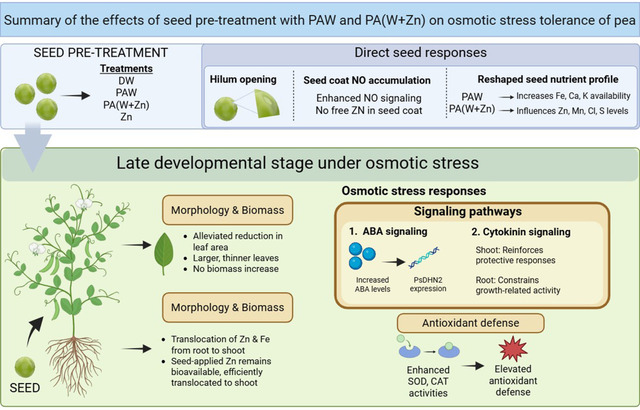
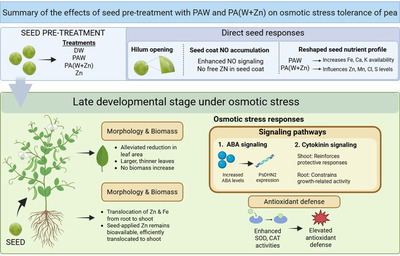
Plasma-activated water (PAW) seed treatment is an emerging green technology that enhances plant germination and growth; however, its role in drought stress tolerance remains unclear. In this study, pea (Pisum sativum L.) seeds were treated with PAW (10 mg L⁻¹ nitrite, 30 mg L⁻¹ nitrate, pH 3.9), Zinc (Zn)-enriched PAW (PA(W+Zn); 6 mg L⁻¹ hydrogen peroxide (H₂O₂), 19 mg L⁻¹ nitrite, 20 mg L⁻¹ nitrate, 14 mg L⁻¹ Zn, pH 4.7), distilled water (DW), or Zn-enriched DW. Subsequently, three-week-old plants were subjected to osmotic stress using polyethylene glycol 8000 (PEG8000) (20% w/v). PAW induced partial hilum opening and mild seed coat damage, while PA(W+Zn) increased nitric oxide (NO) accumulation. Both treatments enhanced nutrient levels and shootward translocation, particularly of Zn and iron (Fe). Under stress, PAW promoted the formation of larger but thinner leaves, indicating adaptive morphological responses. However, stomatal conductance, relative water content, photosynthesis, and starch accumulation remained unaffected. Unchanged proline levels and reduced soluble sugars suggest that classical osmotic acclimation was not induced by PAW treatments. Instead, both PAW and PA(W+Zn) increased abscisic acid (ABA) levels and PsDHN2 expression, indicating activation of ABA-dependent stress signalling, likely mediated by nitrate-, nitrite-, and H2O2-derived signals. Tissue-specific cytokinin (CK) responses and enhanced antioxidant enzyme activities (superoxide dismutase [SOD], catalase [CAT]) further suggest the establishment of a primed state. Overall, PAW-based seed treatments induce complex physiological and molecular responses involving ABA signalling, selected ion translocation, and antioxidant enzymes without significantly improved water status, stomatal regulation, or photosynthetic performance.
| Item Type: | Article |
|---|---|
| Uncontrolled Keywords: | Abscisic acid, Cytokinin, Nitric oxide, Osmotic stress, PeaPlasma-activated water, Seed treatment |
| Subjects: | Q Science / természettudomány > QK Botany / növénytan > QK10 Plant physiology / növényélettan |
| SWORD Depositor: | MTMT SWORD |
| Depositing User: | MTMT SWORD |
| Date Deposited: | 01 Oct 2026 06:35 |
| Last Modified: | 01 Oct 2026 06:35 |
| URI: | https://real.mtak.hu/id/eprint/248121 |
Actions (login required)
 |
View Item |