Fülöp, Dániel and Rácz, Adél Sarolta and Olasz, Dániel and Gyulai, Gergő (2026) Investigating the Micelle-Templated Formation of Fluorescent Carbon Nanoparticles via Batch and Microfluidic Hydrolysis of Hexadecylpyridinium Bromide. ACS APPLIED NANO MATERIALS, 9 (30). pp. 14310-14325. ISSN 2574-0970
![[img]](https://real.mtak.hu/style/images/fileicons/text.png) |
Text
acsanm.6c02095.pdf - Published Version Restricted to Registered users only Download (8MB) | Request a copy |
|
![[img]](https://real.mtak.hu/243714/7/m_an6c02095_0008.png)
|
Text (graphical abstract)
m_an6c02095_0008.png - Published Version Download (108kB) | Preview |
Abstract
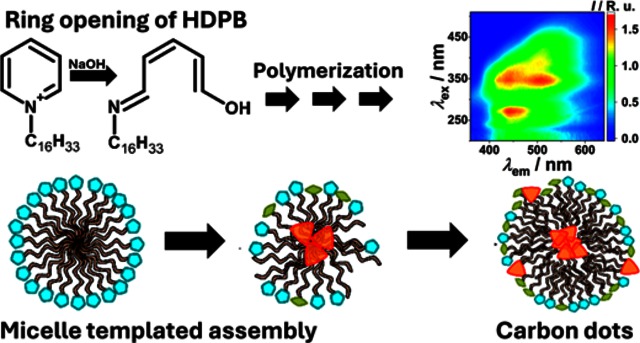
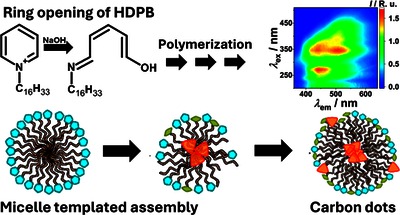
Carbon nanoparticles (CNPs) are typically synthesized through energy-intensive carbonization processes that offer limited control over size and surface chemistry. Here, we report a refined, low-energy synthetic route using the base-induced hydrolysis of hexadecylpyridinium bromide (HDPB). Under moderate thermal conditions (70–90 °C), uniform fluorescent CNPs are formed within 10 min. To optimize scalability and reproducibility, the synthesis was adapted to a continuous-flow microfluidic platform. This transition facilitated superior heat and mass transfer, enabling precise tuning of average particle diameter (1.7–3.4 nm) and the suppression of dispersity through strictly regulated reaction parameters. Structural characterization via ATR-IR and XPS identifies a formation pathway starting with the Zincke ring-opening of the pyridinium headgroup, followed by the assembly of conjugated domains via aza-aldol condensations. Potentiometric titrations and electrophoretic mobility measurements reveal a complex surface architecture dominated by imine and carboxyl groups. Despite the presence of anionic carboxyl sites, the nanoparticles exhibit a strong positive ζ-potential at neutral pH, a phenomenon attributed to the adsorption of cationic intermediates within the particle matrix. The resulting CNPs display stable, multimodal fluorescence with a quantum yield of 1–2%. We propose a micelle-templated particle formation mechanism where HDPB micelles serve as confined reaction sites that guide the oriented assembly of intermediate chains. The hexadecyl chains play a critical dual role, acting as steric stabilizers that terminate polymer growth while governing interfacial hydrophobicity. This research establishes a comprehensive mechanistic and synthetic framework for the design of tailored carbon-based nanomaterials, offering a sustainable pathway for developing precision-engineered probes for optoelectronics and targeted drug delivery.
| Item Type: | Article |
|---|---|
| Uncontrolled Keywords: | carbon nanoparticles, continuous-flow synthesis, micelle-templated growth, photoluminescence, reaction mechanism |
| Subjects: | Q Science / természettudomány > QD Chemistry / kémia |
| SWORD Depositor: | MTMT SWORD |
| Depositing User: | MTMT SWORD |
| Date Deposited: | 03 Aug 2026 09:22 |
| Last Modified: | 03 Aug 2026 09:22 |
| URI: | https://real.mtak.hu/id/eprint/243714 |
Actions (login required)
 |
Edit Item |