Itskou, Ioanna and Sageer, Sharminaz C. and Dawson, Daniel M. and Kafizas, Andreas and Nevjestic, Irena and McGilvery, Catriona M. and Dabóczi, Mátyás and Kerherve, Gwilherm and Eslava, Salvador and Heutz, Sandrine and Ashbrook, Sharon E. and Petit, Camille (2025) Boron-Functionalized Graphitic Carbon Nitride Materials for Photocatalytic Applications: Effects on Chemical, Adsorptive, Optoelectronic, and Photocatalytic Properties. ACS MATERIALS AU, 5 (4). pp. 656-674. ISSN 2694-2461
|
Text
mg5c00007.pdf - Published Version Download (10MB) | Preview |
|
![[img]](https://real.mtak.hu/245770/7/m_mg5c00007_0016.png)
|
Text (graphical abstract)
m_mg5c00007_0016.png - Published Version Download (113kB) | Preview |
Abstract
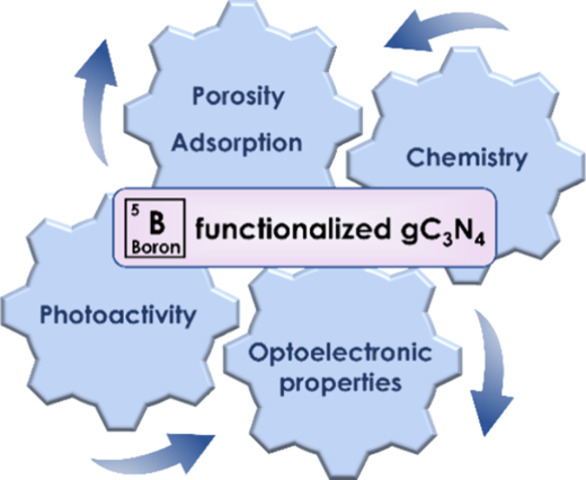
Graphitic carbon nitride (gC3N4, or CN herein) is widely studied as a photocatalyst owing to its ease of synthesis, high stability, and optoelectronic properties. However, its photocatalytic performance often remains limited, and a common approach to tune its function and enhance its performance is by doping. Boron (B) functionalization of CN has showed a potential benefit on photocatalytic performance for several reactions. However, the reason for this improvement and the links between synthesis method, exact B chemical environment, and performance remain unclear. Here, we present a fundamental study that elucidates the influence of (i) B functionalization, (ii) B content, and (iii) choice of B precursor on the physicochemical, adsorptive, optoelectronic, and photocatalytic properties of bulk B-CN. We synthesized two sets of B-CN materials (0.5–11 at% B), using either elemental boron or boric acid as precursors. The samples were characterized using several imaging and spectroscopic techniques, which confirm the integration of B into the material through B–O bonding and the creation of B clusters in the case of the boron precursor, with density functional theory (DFT) calculations supporting our analyses. The distribution of B atoms within B-CN particles remained heterogeneous. Compared to CN, B-functionalized materials show enhanced porosity and CO2 uptake, with similar degrees of light absorption and deeper energy band positions. Transient absorption spectroscopy (TAS) measurements showed that charge carrier populations, lifetimes, and kinetics were not significantly affected by B functionalization; however, at 5 at% B doping, an increase in the concentration of charge carriers was seen. Higher B content enhances the photocatalytic NOx removal under UVA irradiation (almost two-fold) and the selectivity to NO3– from NOx photooxidation, but has no significant effect on CO2 photoreduction, compared to pristine CN. Overall, this study provides fundamental insights to build on and more rationally produce better-performing B-CN photocatalysts.
| Item Type: | Article |
|---|---|
| Uncontrolled Keywords: | XPS; NMR spectroscopy; boron; Photocatalysis; CO2; graphitic carbon nitride; NO x; |
| Subjects: | Q Science / természettudomány > QD Chemistry / kémia |
| SWORD Depositor: | MTMT SWORD |
| Depositing User: | MTMT SWORD |
| Date Deposited: | 08 Sep 2026 07:52 |
| Last Modified: | 08 Sep 2026 07:52 |
| URI: | https://real.mtak.hu/id/eprint/245770 |
Actions (login required)
 |
View Item |