Dabóczi, Mátyás and Ratnasingham, Sinclair R and Mohan, Lokeshwari and Pu, Chenfeng and Hamilton, Iain and Chin, Yi-Chun and McLachlan, Martyn A and Kim, Ji-Seon (2021) Optimal interfacial band bending achieved by fine energy level tuning in mixed-halide perovskite solar cells. ACS ENERGY LETTERS, 6 (11). pp. 3970-3981. ISSN 2380-8195
|
Text
nz1c02044.pdf - Published Version Download (3MB) | Preview |
|
![[img]](https://real.mtak.hu/245836/7/m_nz1c02044_0008.png)
|
Text (graphical abstract)
m_nz1c02044_0008.png - Published Version Download (90kB) | Preview |
Abstract
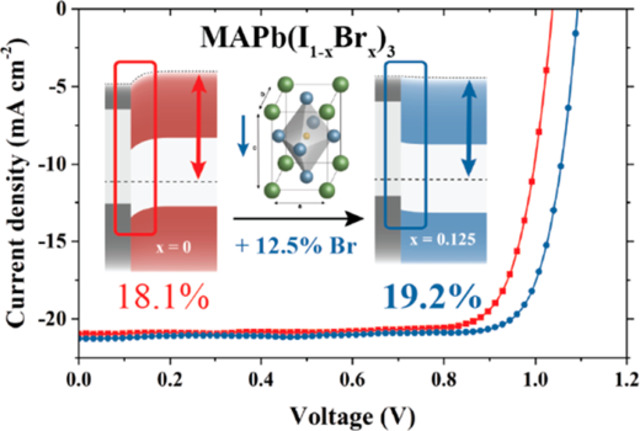
Most highly efficient perovskite solar cells employ mixed iodide–bromide photoactive layers; however, understanding the beneficial effect of the low (5–15 mol %) bromide content is incomplete. Here, a series of MAPb(I1–xBrx)3 perovskite layers are investigated to understand the origin of the high peak power conversion efficiency (19.2%) observed at small bromide content (0.10 ≤ x ≤ 0.125). For the x = 0.125 perovskite, 200 meV shallower energy levels are revealed, accompanied by a reduced density of trap states and stable tetragonal mixed-halide phase with compressed unit cell. In contrast, the higher bromide content samples (x > 0.125) show deeper energy levels, cubic perovskite crystal structure, and signs of halide segregation. Surface photovoltage measurements unveil an undesirable band bending at the hole transport layer/perovskite interface for MAPbI3 and x > 0.125 mixed-halide layers, which is eliminated for the x = 0.125 perovskite because of its shallower Fermi level, enabling enhanced device performance.
| Item Type: | Article |
|---|---|
| Subjects: | T Technology / alkalmazott, műszaki tudományok > TK Electrical engineering. Electronics Nuclear engineering / elektrotechnika, elektronika, atomtechnika |
| SWORD Depositor: | MTMT SWORD |
| Depositing User: | MTMT SWORD |
| Date Deposited: | 08 Sep 2026 13:55 |
| Last Modified: | 08 Sep 2026 13:55 |
| URI: | https://real.mtak.hu/id/eprint/245836 |
Actions (login required)
 |
View Item |