Kunszabó, Atilla and Kasza, Gyula and Szakos, Dávid and Oláh, Judit and Lakner, Zoltán and Popp, József and Nugraha, Widya Satya and Dorkó, Annamária and Süth, Miklós (2025) Household food waste - consumer intentions and capacities for further reduction considering different food waste categories. SUSTAINABLE CHEMISTRY AND PHARMACY, 48. No. 102209. ISSN 2352-5541
|
Text
1-s2.0-S2352554125003079-main.pdf - Published Version Available under License Creative Commons Attribution. Download (2MB) | Preview |
|
![[img]](https://real.mtak.hu/246143/7/1-s2.0-S2352554125003079-ga1_lrg.jpg)
|
Text (graphical abstract)
1-s2.0-S2352554125003079-ga1_lrg.jpg - Published Version Available under License Creative Commons Attribution. Download (371kB) | Preview |
Abstract
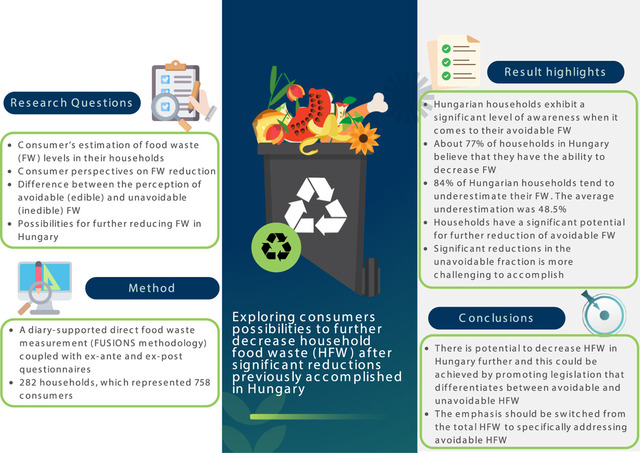
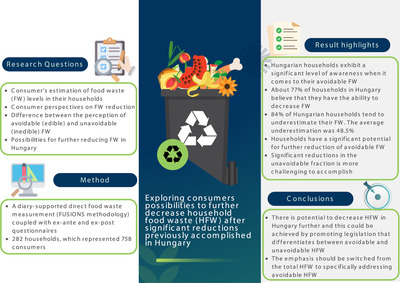
Recently, EU legislation has addressed Sustainable Development Goal 12.3, introducing legally binding targets for the Member States for the reduction of food waste across sectors by 2030 compared to 2020 levels. The mandatory reduction target is 30 % in retail and consumption levels (including households), and 10 % in the processing and manufacturing sectors. The current study includes household food waste data from 282 voluntary households in 2021. Data was collected by following a diary-supported direct food waste measurement methodology (FUSIONS methodology), completed by pre- and post-study questionnaire surveys with one respondent from each household. Avoidable (edible) food waste dropped by 23.99 % (from 33.14 kg/capita/year to 25.19 kg/capita/year) between 2016 and 2021. The reduction of total FW was only 3.73 % (68.04 kg/capita/year in 2016 and 65.50 kg/capita/year in 2021). Possibilities for further FW reduction in Hungarian households were investigated. This study found that 84 % of the households underestimated their actual total FW generation, and the average level of underestimation was 48.5 %. Research data suggests that unavoidable FW is not perceived to be wastage by the respondents. According to post-study questionnaire results, 77 % of the respondents believe they can further reduce the FW in their households. The finding suggests that, despite the decrease in household food waste from 2016 to 2021, there is considerable potential for further reduction, especially in the avoidable category. This potential is in line with broader goals of reducing food waste in households, contributing to national and EU targets for sustainable resource management and food waste reduction.
| Item Type: | Article |
|---|---|
| Uncontrolled Keywords: | consumer study; sustainable development goals (SDGs); Household food waste; |
| Subjects: | T Technology / alkalmazott, műszaki tudományok > TD Environmental technology. Sanitary engineering / környezetvédelem, hulladékkezelés, egészségügyi mérnöki technika (ivóvízellátási és szennyvízkezelési technika) |
| SWORD Depositor: | MTMT SWORD |
| Depositing User: | MTMT SWORD |
| Date Deposited: | 14 Sep 2026 09:13 |
| Last Modified: | 14 Sep 2026 09:13 |
| URI: | https://real.mtak.hu/id/eprint/246143 |
Actions (login required)
 |
View Item |