Péterfi, Orsolya and Mészáros, Lilla Alexandra and Szabó, Bence and Ficzere, Máté and Nagy, Brigitta and Sipos, Emese and Lenk, Sándor and Nagy, Zsombor Kristóf and Galata, Dorián László (2026) ANN-assisted UV imaging for non-destructive dissolution prediction of HPMC matrix tablets. INTERNATIONAL JOURNAL OF PHARMACEUTICS, 692. No. 126649. ISSN 0378-5173
|
Text
50_Peterfi_etal_2026_IntJPharma.pdf - Published Version Available under License Creative Commons Attribution. Download (11MB) | Preview |
|
![[img]](https://real.mtak.hu/247006/7/1-s2.0-S0378517326000979-ga1_lrg.jpg)
|
Text (graphical abstract)
1-s2.0-S0378517326000979-ga1_lrg.jpg - Published Version Available under License Creative Commons Attribution. Download (99kB) | Preview |
Abstract
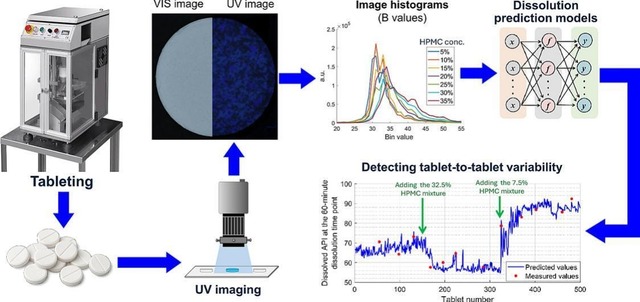
This study investigates the use of UV imaging combined with artificial neural networks (ANNs) to estimate the dissolution behaviour of extended-release hydroxypropyl methylcellulose (HPMC) matrix tablets. UV illumination enables the detection of HPMC, allowing polymer-specific optical information to be extracted. Caffeine was used as the model active pharmaceutical ingredient, and HPMC served as the matrix-forming polymer. Formulations were prepared with HPMC contents ranging from 5% to 35%. The ANN models were trained using colourimetric information extracted from UV images of the tablets. Among all models evaluated, the one based on the blue channel of the RGB colour space showed the best performance, achieving an average f2 similarity factor of 80.68 on the dissolution curves of the external validation set. To evaluate the performance of the trained model on an external test set under dynamic conditions, powder blends with different HPMC contents were introduced sequentially, resulting in gradual changes in tablet composition. The trained model reflected these formulation changes in the predicted dissolution profiles, capturing the shifts in release behaviour associated with the varying HPMC levels throughout the experiment. UV imaging provided relevant input for dissolution modelling and enabled the rapid, non-destructive assessment of formulation-dependent drug release. The results therefore extend the applicability of imaging-based methods to excipient-level formulation changes.
| Item Type: | Article |
|---|---|
| Additional Information: | The project was supported by the European Union project RRF-2.3.1–21–2022–00004 within the framework of the Artificial Intelligence National Laboratory. Further support was received by the János Bolyai Research Scholarship of the Hungarian Academy of Science. The project supported by the Doctoral Excellence Fellowship Programme (DCEP) is funded by the National Research Development and Innovation Fund of the Ministry of Culture and Innovation and the Budapest University of Technology and Economics, under a grant agreement with the National Research, Development and Innovation Office. This project has received funding from the European Union’s Horizon Europe research and innovation programme under the Marie Skłodowska-Curie grant agreement No 101207440. |
| Uncontrolled Keywords: | Dissolution prediction; Artificial neural network; Machine vision; UV imaging; PAT; Extended release |
| Subjects: | R Medicine / orvostudomány > RM Therapeutics. Pharmacology / terápia, gyógyszertan |
| SWORD Depositor: | MTMT SWORD |
| Depositing User: | MTMT SWORD |
| Date Deposited: | 21 Sep 2026 12:23 |
| Last Modified: | 21 Sep 2026 12:23 |
| URI: | https://real.mtak.hu/id/eprint/247006 |
Actions (login required)
 |
View Item |