Szentiványi, Tamara and Bruszniczky, Borbála and Biró, Zsolt and Katona, Krisztián and Klein, Ágnes and Bende, Attila and Bánáti, László and Vass, Gábor and Lehotzky, Pál and Kovács, Dorottya and Földvári, Gábor and Csivincsik, Ágnes and Nagy, Gábor and Nagy, Rebeka Ráhel and Miklós, Máté and Szabadi, Kriszta Lilla and Szabó, Éva S. and Garamszegi, László Z. (2026) Unwelcome guests: Nematodes of zoonotic and animal health importance in native and invasive carnivores of Hungary. CURRENT RESEARCH IN PARASITOLOGY & VECTOR-BORNE DISEASES, 9. No. 100380.
|
Text
2026_Unwelcome guests.pdf - Published Version Available under License Creative Commons Attribution Non-commercial. Download (5MB) | Preview |
|
![[img]](https://real.mtak.hu/247044/2/1-s2.0-S2667114X26000361-ga1_lrg.jpg)
|
Text (graphical abstract)
1-s2.0-S2667114X26000361-ga1_lrg.jpg - Published Version Available under License Creative Commons Attribution Non-commercial. Download (695kB) | Preview |
Abstract
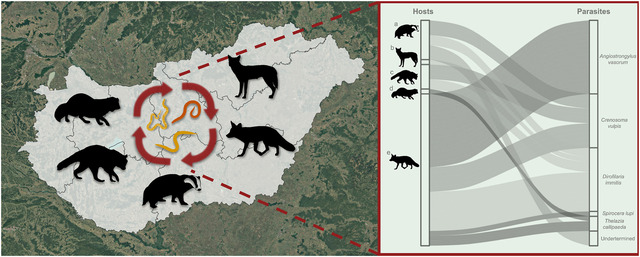
Wild carnivores are important reservoirs of parasitic nematodes, several of which have veterinary and zoonotic significance. In Europe, the role of invasive carnivores in parasite circulation remains poorly understood. Here, we screened 371 individuals of six wild carnivore species from Hungary (red foxes, badgers, golden jackals, raccoons, raccoon dogs, and beech martens), using molecular markers (cox1 and S12), and detected five nematode parasites: Dirofilaria immitis, Crenosoma vulpis, Angiostrongylus vasorum, Thelazia callipaeda, and Spirocerca lupi. The highest prevalence was observed in badgers (32.0%) and red foxes (15.7%), while invasive raccoons also showed a relatively high infection rate (13.2%). Dirofilaria immitis was one of the most common nematode species detected: it was found in four host species, including the first confirmed cases in Hungarian badgers and invasive raccoons, extending the known host range of this parasite in central Europe. Importantly, T. callipaeda was recorded in red foxes and an invasive raccoon dog, representing the first invasive host records of this zoonotic eyeworm in Hungary. Crenosoma vulpis was identified in raccoons, suggesting invasive species may act as incidental carriers of endemic parasites. Both C. vulpis and D. immitis showed low host specificity. These findings indicate that invasive carnivores, particularly raccoons, may harbour unexpectedly high prevalence and play a greater role in local parasite networks than previously assumed. Our results highlight the epidemiological significance of both native and invasive carnivores in sustaining nematodes of zoonotic and veterinary importance in central Europe, stressing the need for continued surveillance in wild carnivores.
| Item Type: | Article |
|---|---|
| Uncontrolled Keywords: | Heartworm; Invasive species; Parasitic nematodes; Zoonoses |
| Subjects: | Q Science / természettudomány > QL Zoology / állattan |
| Depositing User: | Tamara Szentiványi |
| Date Deposited: | 21 Sep 2026 11:20 |
| Last Modified: | 21 Sep 2026 11:20 |
| URI: | https://real.mtak.hu/id/eprint/247044 |
Actions (login required)
 |
View Item |