Stoyanova, Stela and Georgieva, Elenka and Kovacheva, Eleonora and Antal, László and Somogyi, Dóra and Uzochukwu, Ifeanyi Emmanuel and Nagy, László and Nyeste, Krisztián József and Yancheva, Vesela (2025) Kidneys Under Siege: Pesticides Impact Renal Health in the Freshwater Fish Common Carp (Cyprinus carpio Linnaeus, 1758). TOXICS, 13 (7). No. 518. ISSN 2305-6304
|
Text
toxics-13-00518.pdf - Published Version Available under License Creative Commons Attribution. Download (2MB) | Preview |
|
![[img]](https://real.mtak.hu/247081/7/toxics-13-00518-ag.png)
|
Text (graphical abstract)
toxics-13-00518-ag.png - Published Version Available under License Creative Commons Attribution. Download (2MB) | Preview |
Abstract
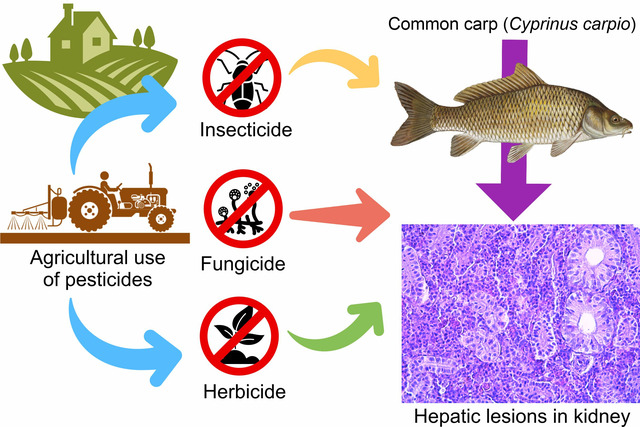
This study evaluated the histopathological impact of three commonly used pesticides—pirimiphos-methyl, propamocarb hydrochloride, and 2,4-dichlorophenoxyacetic acid (2,4-D)—on the kidneys of common carp (Cyprinus carpio Linnaeus, 1758) after 96-h acute exposure. The histopathological analysis demonstrated that all three tested pesticides induced structural changes. The histopathological changes were assessed using a semi-quantitative scoring system and categorised into circulatory, degenerative, proliferative, and inflammatory alterations. While circulatory alterations were absent in all treatments, clear and statistically significant degenerative, proliferative, and inflammatory responses were recorded, which escalated with increasing pesticide concentrations. Additionally, various statistical analyses were conducted to evaluate the lesions in kidney structure and function. Before the statistical analysis, normality and variance homogeneity were assessed using the Shapiro–Wilk and Levene’s tests, respectively. Due to non-normal data distribution, non-parametric methods were applied. Hence, the non-parametric statistical methods showed distinct group-level differences in the kidney damage indices. The Kruskal–Wallis test revealed significant differences across treatments (p < 0.001), and Mann–Whitney U tests identified specific pairwise differences. The degenerative and proliferative lesions were most prominent in fish exposed to 2,4-D at 100 µg/L (IK = 34), followed by pirimiphos-methyl and propamocarb hydrochloride. Inflammatory changes were mainly observed in the pirimiphos-methyl groups. The histopathological lesions were concentration-dependent, with 2,4-D causing irreversible renal damage at higher concentrations. These findings highlight the nephrotoxic risks posed by common pesticides and validate that the use of histopathological indices, combined with robust non-parametric testing, provides a reliable approach to evaluating organ-specific pesticide toxicity. These biomarkers offer sensitive early warning indicators of environmental risk, reinforcing the suitability of common carp as a model species for ecotoxicological assessment.
| Item Type: | Article |
|---|---|
| Uncontrolled Keywords: | common carp; kidney; histological biomarkers; pesticides; pollution |
| Subjects: | Q Science / természettudomány > QH Natural history / természetrajz > QH301 Biology / biológia |
| SWORD Depositor: | MTMT SWORD |
| Depositing User: | MTMT SWORD |
| Date Deposited: | 21 Sep 2026 13:50 |
| Last Modified: | 21 Sep 2026 13:50 |
| URI: | https://real.mtak.hu/id/eprint/247081 |
Actions (login required)
 |
View Item |